What is a sole trader business bank account and do you need one?
A sole trader business bank account keeps your business income and expenses separate from your personal money. Here's when you need one and how to open it.

Traditional banks often treat a self-employed sole trader as a small, low-priority customer. Yet you still need a reliable way to get paid, pay suppliers and keep your tax records straight.Mixing personal and business transactions in one account works for a while, then tax season arrives and you spend evenings sorting card payments into business expenses and personal spending. For a self employed person running their own business, keeping business money away from personal finances is the simplest habit that saves time and mistakes.This guide explains what a sole trader business bank account is, whether you legally need one in the UK and the EU, what to compare between providers, and how to open a sole trader account online.

What is a sole trader account?
A sole trader business bank account is an account you use only for your business: receiving payments from clients, paying business expenses and tracking income. It keeps your personal and business finances separate, even though legally they belong to the same person.Is a sole trader a separate legal entity?No. A sole trader (called a sole proprietor in the US) is self-employed and runs the business in their own name. Unlike a limited company, a sole trader business isn't a separate legal entity, so you're personally responsible for its debts and pay income tax on its profits through your personal tax return.Sole trader or limited company?A limited company is registered at Companies House and is a separate legal entity: the money belongs to the company, its company directors have legal duties, and it needs its own business account. A sole trader only registers with HMRC for tax purposes, which is why the rules on bank accounts are looser.Do sole traders need a separate business bank account?In the UK, there's no legal requirement for a sole trader to open a separate business bank account. You can run the business through a personal account, as long as you keep accurate records of income and expenses for HMRC. Two things push most sole traders towards a separate account anyway:- Many personal account terms don't allow business use, so check yours before you invoice clients into it.
- Making Tax Digital for Income Tax now requires digital records and quarterly updates for sole traders and landlords with qualifying income over £50,000 (from 6 April 2026). The threshold drops to £30,000 from April 2027 and £20,000 from April 2028, according to HMRC. A separate account makes those digital records much easier to keep.
Key benefits of a separate sole trader business account
Even when it isn't legally required, a dedicated business account makes running a business of one simpler. These are the benefits that matter most.Keep personal and business finances separateA separate account keeps business transactions out of your personal account. That makes it easier to see what the business really earns, avoid claiming the wrong expenses and answer questions from the tax authority if your return is checked.Simpler tax returns and Making Tax DigitalWhen every business transaction sits in one account, your bank statement becomes most of your record keeping. Connect the account to accounting tools or Making Tax Digital software and your quarterly updates and annual tax return take a fraction of the time, with a clearer view of your tax bill and National Insurance.Get paid at home and abroadBusiness accounts are built for invoicing clients, paying contractors and receiving international payments. A euro IBAN lets EU clients pay you by SEPA transfer, including SEPA Instant where both sides support it, while SWIFT covers clients outside the SEPA zone.Cash flow management and accounting toolsA dedicated account with good online banking makes it easier to track income and expenses, spot unusual transactions and plan for tax reporting. Many providers offer invoicing, expense categories and integrations with Xero, QuickBooks or FreshBooks, so a sole trader may not need a separate accounting platform at all.A more professional lookClients see the account name on your invoices and on their payment confirmations. A business account, ideally in your trading name, looks more credible than a personal account, which matters when you start working with larger companies.What about business credit cards and loans?Banks can offer overdrafts, business loans and credit cards to sole traders, usually after you've built a trading history. Electronic money institutions (EMIs) like Narvi can't lend, so if you need credit, keep a relationship with a bank alongside your EMI account.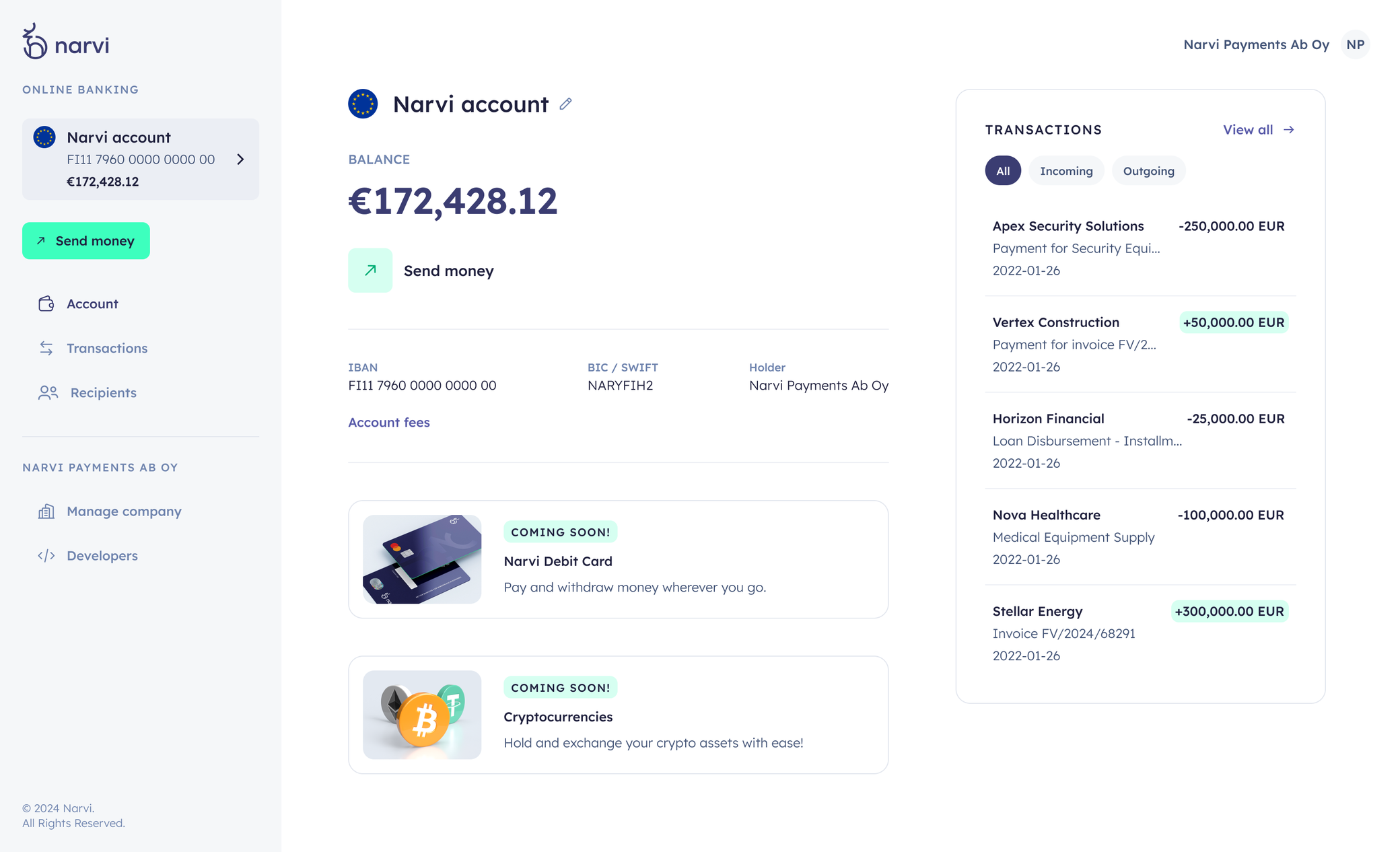
How to choose the right business account provider
You're ready to open a business account, but which business account provider should you pick? These are the factors to compare:Fees: Compare the monthly fee, transaction fees, international transfer charges and currency exchange margins against your real payment volumes. The cheapest headline price isn't always the cheapest account.
Balance and transaction requirements: Some accounts set a minimum balance or limit the number of free transactions. Make sure you can meet these consistently.
Account features: Built-in invoicing, direct debits, cards and integrations with bookkeeping apps save time every month.
Customer service: Read reviews from other self-employed people and check how quickly the provider answers when a payment is stuck.
How your money is protected: UK banks are covered by the Financial Services Compensation Scheme (FSCS) up to £120,000 per eligible person per bank, a limit that applies from 1 December 2025 according to the Bank of England. EMIs aren't covered by deposit guarantee schemes, but they must safeguard client funds separately from their own money.
Sole trader bank account requirements and how to apply
Opening a business account takes a little more work than a personal account, because the provider has to run KYC checks on you and your business. With Narvi, the process looks like this:- Choose your country
- Create an account with an email and password
- Verify your email and phone number
- Complete the questionnaire with your personal details, address, country of residence, tax identification number (TIN), the reason for opening the account and your source of funds.
- Upload the documents listed below
- Photo ID and proof of address, such as a recent utility bill or bank statement
- Your business address, if it differs from your home address
- Proof that your business is registered, for example your Self Assessment registration and UTR in the UK or a trade register extract in the EU
- A short description of your business, or a business plan if you're just starting
- Contracts or invoices that show the business is active
What fees come with a sole trader account?
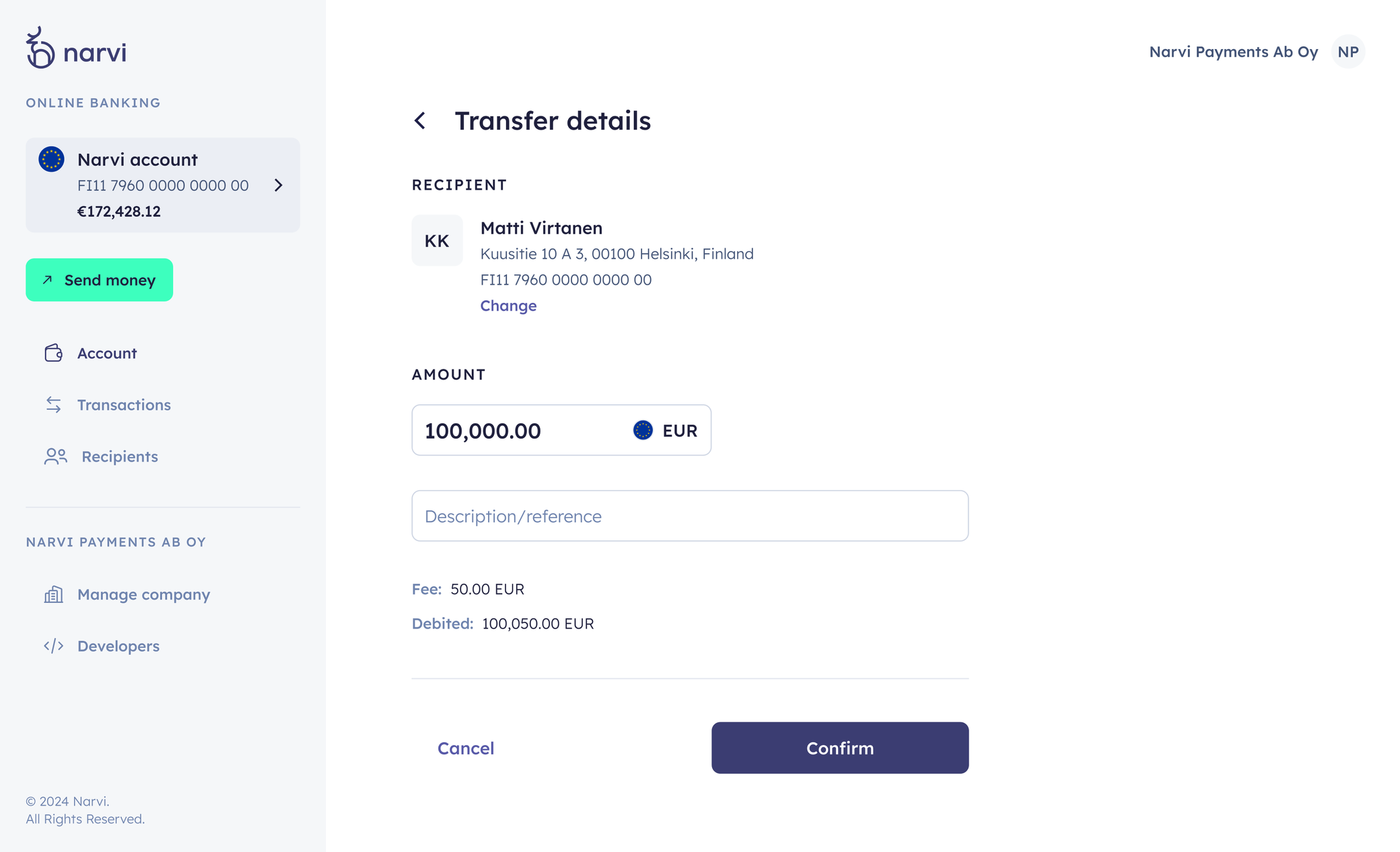
Fees vary by provider. Narvi uses pricing tiers based on where you're based, your business model and the compliance review it needs:- European startups within the European Economic Area (EEA) with resident directors and low-risk business models
- International companies in low-risk countries outside the EEA
- Medium-risk companies that need a closer compliance review
- Enterprise customers with custom plans. Sole traders are unlikely to fall into this tier, unlike limited companies with complex operations.
- a one-time onboarding fee plus three months of monthly deposits
- a monthly fee that depends on your tier and any added compliance requirements
- a minimum balance equal to three months of monthly fees, so your account stays positive
- €1 per internal transfer between Narvi accounts
- SWIFT transfers, which may carry additional fees from the banks in the payment chain
UK sole traders: when an EU account makes sense
Narvi accepts sole traders from the UK as well as the EU. Before you apply, it helps to know what the account does and doesn't do for a UK business:- You get a euro IBAN. EU clients pay you by SEPA transfer, usually the same or next business day.
- Balances are held in euros. UK clients paying you send an international transfer to your IBAN, not a Faster Payment to a sort code and account number.
- Your money is safeguarded by an EMI licensed in Finland, not covered by the FSCS.
- Narvi doesn't offer overdrafts, loans or cash deposits.
Your solution
Open a sole trader account with Narvi
Narvi Payments is an e-money institution licensed by the Finnish Financial Supervisory Authority (FIN-FSA). It provides business accounts with dedicated IBANs to sole traders, startups and established companies, and can serve clients across the 30 EEA countries.You apply online, talk to a real person in customer support when you need help, and get one account for euro and international payments. You can also open a dedicated personal account when you register, so your own money stays separate too.With a Narvi business account, you get:
A dedicated euro IBAN
Online account opening
SEPA and SWIFT transfers
SEPA Instant, 24/7
API integration with your accounting or expense software
Support from a real person when you need it
FAQ
Legally, yes: UK sole traders don't have to open a separate business account. But many personal account terms don't allow business use, and mixing transactions makes record keeping for Self Assessment and Making Tax Digital harder, so most sole traders open a separate account.
No. Making Tax Digital for Income Tax requires digital records and quarterly updates through compatible software, not a business account. A separate account just makes it much easier to link your transactions to that software.
At a UK bank, deposits are covered by the FSCS up to £120,000 per eligible person per bank. At an EMI such as Narvi, client funds are safeguarded: kept separate from the company's own money so they can be returned if the EMI fails.
Yes. Most digital banks and EMIs let you open a sole trader account online. You verify your identity, upload proof of address and business registration, and the provider reviews your application, usually within a few business days.
Yes, some EU providers accept UK sole traders. Narvi does, for example. You get a euro IBAN, which suits UK sole traders with EU or international clients.
Looking for a simpler way to run your business finances as a sole trader? Open an account online today.Apply for a sole trader account

Updated November 2, 2026Author
This publication is provided for general information purposes and does not constitute legal, tax, or other professional advice from Narvi Payments Oy Ab or its affiliates, and it is not intended as a substitute for obtaining advice from a financial advisor or any other professional.
- Eric Carriere is a fintech writer and entrepreneur with over a decade of experience in B2B and digital strategy. As a founder, Eric offers practical insights into solopreneurship and small business operations, helping businesses navigate the evolving fintech and SaaS landscape.
This publication is provided for general information purposes and does not constitute legal, tax, or other professional advice from Narvi Payments Oy Ab or its affiliates, and it is not intended as a substitute for obtaining advice from a financial advisor or any other professional.
Read next:
How to Open a Bank Account in Finland?
What are the requirements for setting up a bank account in Finland? And, is there an alternative to traditional banking? We’ll get answers to these questions and more below. Keep reading to learn more!
How to Track SWIFT Payments?
Tired of wondering where your international payments are and when they will arrive? Tracking SWIFT can be a challenging task, but it doesn't have to be. In this article, we’ll explore everything you need to know to track your wire transfers.
What is Your TIN Number?
Every business entity has a Tax ID number (TIN). These digits are unique identifiers used to track finances across borders. Click for a detailed country guide on how to find your TIN.


Solutions
IBAN Accounts For Your Business
Commencez ici
A propos de Narvi (EN)
Alternative Investment Funds [whitepaper]Family Offices [whitepaper]Shipping Industry [whitepaper]How to Open a Business Account in FinlandNarvi vs. Wise, Revolut, N26, and other alternativesNarvi vs. Stable.comNarvi vs. payabl.Narvi vs. ConnectPayNarvi vs. IBAN4UNarvi vs. GenomeNarvi vs. PaxumNarvi vs. BilderlingsNarvi vs. NetellerNarvi vs. KontistBlogPayments Glossary


Narvi Payments Oy Ab est un établissement de monnaie électronique agréé (EMI). La licence IME de Narvi est accordée par l'Autorité finlandaise de surveillance financière (FIN FSA) avec le numéro d'enregistrement 3190214-6. La licence de Narvi est passeportée pour tous les pays de l'Union européenne.
 Construite et réglementée en Finlande
© 2026 Narvi. All Rights Reserved.
v1.330.0