iGaming payment services: what licensed operators need from a payment account
iGaming payment services cover three separate jobs: taking player deposits, holding the money once it settles, and paying out winnings. Here is which provider does what, what each one checks before it takes you on, and where an e-money institution account fits.

iGaming payment services are the providers and payment rails an online gambling business uses to take player deposits, hold money and pay out winnings. Most operators need three different kinds of provider to do that, and the most expensive mistake is assuming one of them covers the other two.A payment gateway or payment service provider (PSP) takes the deposit. An account provider, either a bank or an e-money institution (EMI), holds the money once it settles. Payout rails such as SEPA Instant send it back to players. This guide explains each layer, what providers check before they onboard a gambling business, and where Narvi fits.It is written for payments, finance and compliance leads at licensed operators, platforms and affiliates in the EEA. Get the account layer wrong and the cost is late payouts, frozen funds or a licence condition you can't meet.

The three layers of iGaming payment services
Ask ten operators what their payment provider does and you will get ten answers, because the industry uses one phrase for three jobs. Separating them makes it easier to see where a gap or a single point of failure sits.1. Gateways and PSPs take the depositA payment gateway passes card, e-wallet, open banking or local payment method data from the cashier page to whoever processes it. A PSP or acquirer then processes the payment and settles the money to you, usually in batches and minus fees. This is the layer most people mean by "iGaming payment processing". It decides which payment methods players see and how many deposits are approved.Because gambling is a higher-risk category for card processing, acquirers often settle with a delay or hold back a share of volume as a reserve. Read the settlement terms as carefully as the pricing: they decide how much of your money sits outside your account at any moment.2. The account holds the moneySettlements from every PSP land in a business account. That account also pays staff, suppliers, platform fees, affiliates and taxes, and in many markets it is where segregated player funds sit. This is the layer regulators look at when they ask how player money is protected, and it is the hardest one to replace at short notice.The account can come from a bank or from an e-money institution. An EMI is authorised under the Electronic Money Directive (2009/110/EC), issues IBANs and runs payments, but cannot lend client money. It must safeguard client funds instead.3. Payout rails send money backMany withdrawals go out by bank transfer rather than card refund, and players compare withdrawal speed across brands. In the euro area, SEPA Instant credit transfers settle in seconds, and since 9 October 2025 the Instant Payments Regulation (EU) 2024/886 has required payment providers in the euro area that offer standard euro transfers to offer instant ones as well. For an operator, that makes instant payouts a baseline expectation rather than a feature.Payout rules are also getting stricter about destination. Finland's new Gambling Act frames deposits as transfers from the player's own account, and Dutch rules require payment instruments to trace back to the player. Your account has to support high-volume outgoing transfers to verified player accounts, with references your reconciliation can match.Payment gateway, PSP, EMI account or bank account: who does what
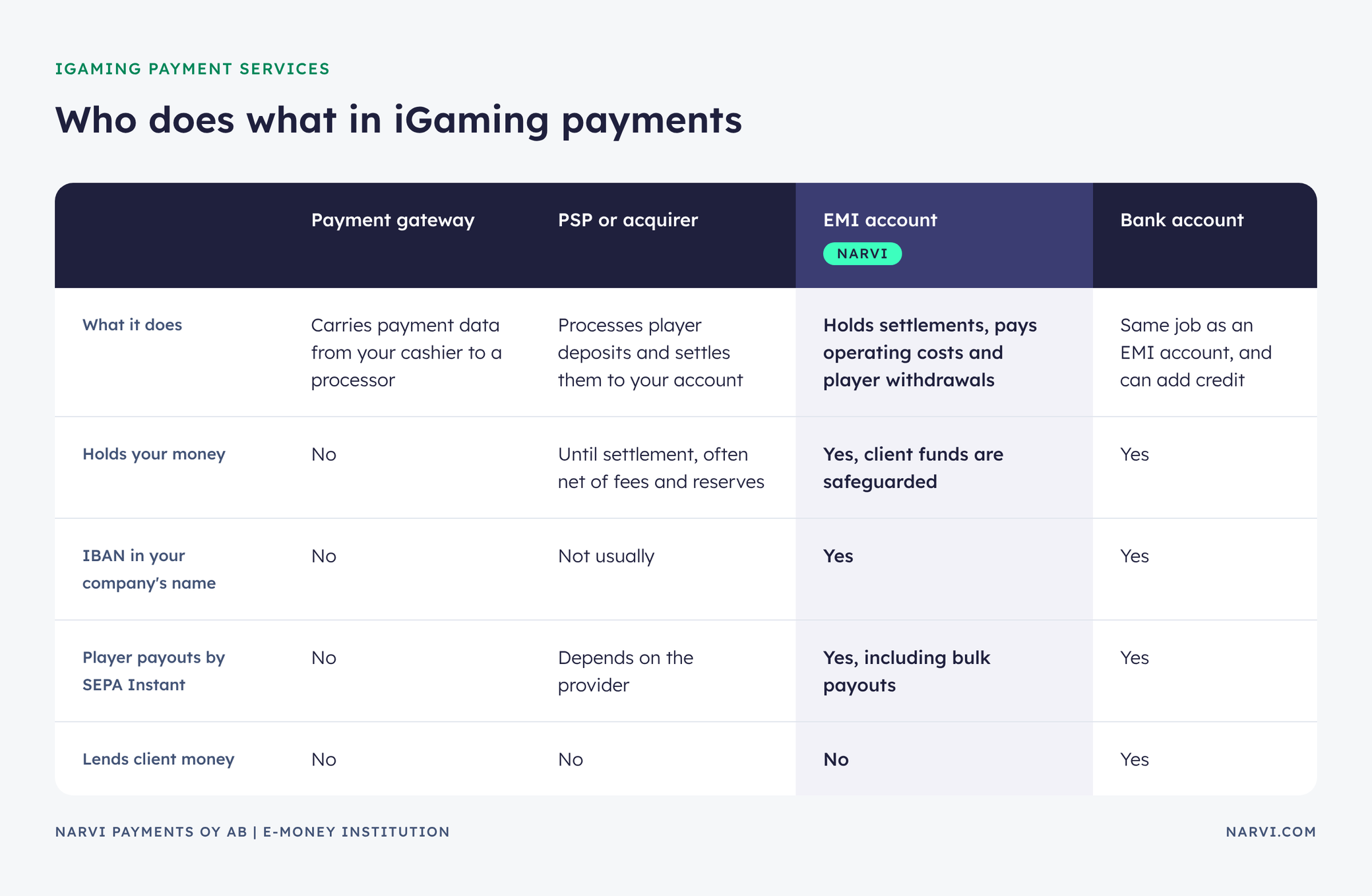
If you are comparing iGaming payment service providers, check which of these four roles each one actually plays. Many cover more than one, few cover all four.The confusion is understandable. Many iGaming payment solutions are sold as one bundle, and a provider that calls itself an iGaming payment gateway may also act as the payment processor, the acquirer or the merchant of record. What matters is who holds the money at each step, and whose name is on the account it lands in.- A payment gateway carries payment data from your cashier to a processor. It does not hold your money.
- A PSP or acquirer processes deposits and settles them to your account, often net of fees and reserves.
- An EMI account gives you an IBAN in your company's name for settlements, operating costs and payouts, with client funds safeguarded rather than lent out.
- A bank account does the same job as an EMI account and can add credit, but banks are often the most restrictive about gambling clients.
How money moves through an online casino
Follow one player deposit and one withdrawal through the stack and the three layers become concrete. This is a typical flow for a licensed online casino or sportsbook in the EEA; the details vary by market and licence.- The player picks one of the payment options in the cashier, for example a card, a digital wallet, open banking or a local payment method.
- The iGaming payment gateway passes the payment to the payment processor or acquirer, which runs its own fraud checks and approves or declines it.
- The PSP credits the player balance straight away, so the player sees a fast deposit, and settles the money to the operator later, net of fees and any reserve.
- The settlement lands in the operator account. Where the licence requires it, player funds are held apart from the operator's own money.
- The player requests a withdrawal. The operator runs its checks: identity, limits, bonus terms and source of funds where needed.
- The operator pays out from its account, often by SEPA Instant, to an account in the player's own name.
- Finance reconciles PSP settlements, player balances and payouts against the account statement.
How to choose iGaming payment service providers
Most operators in the iGaming industry end up with a mix of providers. Judge each one on the job it will do in your stack, not on the length of its feature list.Payment options players expectPlayers in each market expect their own payment methods. Cards, digital wallets, open banking and local schemes all have a place, and the right mix differs between, say, Finland and the Netherlands. A PSP that can't accept payments by the methods your players use will cost you deposits, whatever its pricing.Multiple currencies and marketsAsk which currencies each provider can settle in and which it can hold and pay out in. An online gaming business licensed in several markets may take deposits in more than one currency but pay most of its costs in euros. Know where conversion happens and who sets the rate.Mass payouts and reconciliationWithdrawals are the part of the stack players remember. Check whether your account provider supports mass payouts by file or API, how payment references come back on the statement, and whether your finance team can match them to player IDs without manual work.Fraud prevention and transaction monitoringFraud prevention at the cashier is the PSP's job: card checks, device data and chargeback rules. Transaction monitoring on the account is the account provider's job under AML law. Your own controls sit between the two, and a provider will ask how they work before it onboards you.Regulatory compliance and reportingLicences now set rules for how payments are recorded and reported. Finland's new Gambling Act, for example, requires five years of tamper-proof transaction records. Check that each provider gives you the data in a form you can keep and hand to a supervisor.What account providers check before onboarding a gambling business
Gambling service providers are obliged entities under EU anti-money laundering law, today under Directive (EU) 2015/849 and from 10 July 2027 under the directly applicable AML Regulation (EU) 2024/1624. An account provider onboarding you is checking that you run your own AML framework, and that your flows match what you say you do. Expect questions on:- Your licences: which regulator, which licence numbers, and which markets you serve. Serving players in markets where you hold no licence is a red flag for any provider.
- Ownership and control: the group structure up to the ultimate beneficial owners, with identity documents for each.
- Source of funds and source of wealth for the business and its owners.
- Expected flows: monthly volumes, currencies, countries, which PSPs settle to you and how you pay players.
- Your AML and responsible gambling policies, and who is the responsible person for AML.
- For B2B suppliers and affiliates: contracts showing you supply licensed operators, so you are assessed as what you are rather than as an operator.
Why iGaming businesses get de-risked, and how to reduce the risk
De-risking means a provider exiting a whole category of clients rather than assessing each one. The European Banking Authority's 2022 opinion on de-risking (EBA/Op/2022/01) records national supervisors receiving regular complaints from gambling operators affected by exactly that.You cannot control a provider's risk appetite, but you can make your account easy to keep:- Hold accounts with two providers, so an exit doesn't stop payouts.
- Tell your provider before you enter a new market or add a new PSP, not after the flows change.
- Keep licence renewals and policy updates on file with them as they happen.
- Use payment references your provider can match to players and PSP settlements without asking you.
Where Narvi fits in your iGaming payment services stack
Narvi is the account layer. We do not process card deposits or act as a payment gateway, so you keep the PSPs that convert best in each market and settle them into Narvi.Narvi Payments Oy Ab is an e-money institution authorised by the Finnish Financial Supervisory Authority (FIN-FSA), with its licence passported across the EEA. We work with licensed operators, platforms and game providers, and affiliates.For operatorsA dedicated IBAN for PSP settlements and player payouts, with an account structure you can describe to players and the supervisor when you set up player-fund segregation.For platforms and game providersSettle with operators through one account and connect payments to your platform over the API instead of manual transfers. You are onboarded as what you are, a B2B supplier to iGaming platforms and operators.For affiliatesCollect commissions from every operator into one IBAN, and use SWIFT for operators outside the EEA. You won't be asked for a gambling licence you don't hold.Across all three, you get:- A dedicated IBAN in your company's name, with your funds held apart from other clients' money.
- SEPA Instant and bulk payouts for player withdrawals, plus standard SEPA and SWIFT for suppliers and partners.
- API access for payment initiation, reporting and reconciliation.
- A compliance team that knows gambling licensing documentation and onboards suppliers and affiliates without asking for a gambling licence they don't hold.

Talk to our team about an account for your gaming business

Frequently Asked Questions
They are the providers and payment rails an online gambling business uses to take deposits, hold money and pay out winnings. That usually means one or more payment gateways or PSPs for deposits, a business account with a bank or e-money institution, and payout rails such as SEPA Instant.
A payment gateway carries the payment data from the cashier to the processor. The payment processor, or acquirer, runs the transaction through the card scheme or payment network and settles the money to the merchant. Many iGaming payment solutions bundle both.
No. A payment gateway carries payment data from your cashier to a processor and does not hold your money. An e-money institution provides the account the money settles into, with an IBAN in your company's name, and runs transfers such as SEPA and SWIFT.
Yes, if the EMI accepts gambling clients. Expect to show your licences, ownership structure, source of funds, expected payment flows and AML policies. Narvi works with licensed operators, platforms, game providers and affiliates.
Many use bank transfers rather than card refunds. In the euro area, SEPA Instant settles in seconds, and bulk payout files let an operator send thousands of withdrawals in one batch to players' own accounts.
Gambling service providers are obliged entities under the EU Anti-Money Laundering Directive (EU) 2015/849 as implemented nationally. From 10 July 2027, the AML Regulation (EU) 2024/1624 applies directly in every member state and keeps them in scope.

Last updated: 16 November 2026. Narvi Payments Oy Ab is an authorised Electronic Money Institution licensed by the Finnish Financial Supervisory Authority (FIN-FSA), registration number 3190214-6.DisclaimerThis publication is provided for general information purposes and does not constitute legal, tax, or other professional advice from Narvi Payments Oy Ab or its affiliates, and it is not intended as a substitute for obtaining advice from a financial advisor or any other professional.
Read next:
Finland's new gambling law: what operators need to sort out before 1 July 2027
What the new Gambling Act asks of your payment setup, from segregated player funds to deposit limits and five-year records.
Payment processing systems: what a PSP needs from its accounts and payout rails
How settlement, safeguarding and payout rails fit together for a payment service provider.
What happens to your money if an EMI fails? Safeguarding, explained
How e-money institutions protect client funds, and what that means for your business.

Soluciones
IBAN Accounts For Your Business
Empieza aquí
Acerca de Narvi (EN)
Alternative Investment Funds [whitepaper]Family Offices [whitepaper]Shipping Industry [whitepaper]How to Open a Business Account in FinlandNarvi vs. Wise, Revolut, N26, and other alternativesNarvi vs. Stable.comNarvi vs. payabl.Narvi vs. ConnectPayNarvi vs. IBAN4UNarvi vs. GenomeNarvi vs. PaxumNarvi vs. BilderlingsNarvi vs. NetellerNarvi vs. KontistBlogPayments Glossary


Narvi Payments Oy Ab es una institución de dinero electrónico (EMI) autorizada. La licencia EMI de Narvi la otorga la Autoridad de Supervisión Financiera de Finlandia (FIN FSA) con el número de registro 3190214-6. La licencia de Narvi tiene validez para todos los países de la Unión Europea.
 Construido y regulado por Finlandia
© 2026 Narvi. All Rights Reserved.
v1.335.0