Best European online business bank accounts in 2026
Finding the right business bank account in Europe can be hard, especially for first-time or international business owners.

Understanding the different types of business banking options in Europe
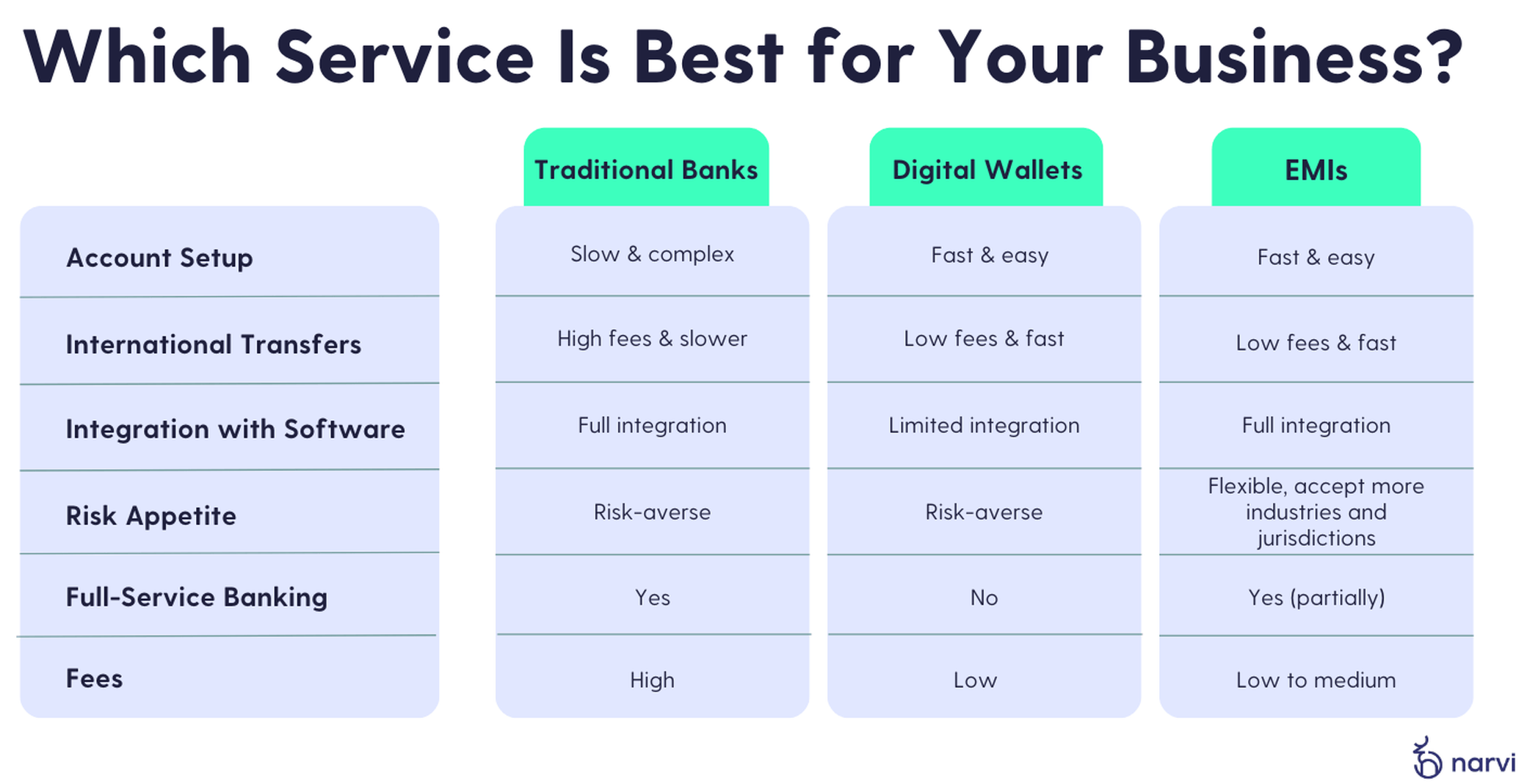
There are three main types of financial institutions that offer financial services to businesses. Each category has its own benefits and drawbacks that should be understood before you make your decision.1. Traditional banksTraditional banks such as Nordea, Danske Bank, and ING have long been the go-to options for businesses. These bank accounts offer a full range of banking services, including business checking accounts, savings accounts, business loans, and credit lines.Accounts with these types of banks are highly regulated and provide peace of mind when it comes to security and oversight.Pros:
- Established reputation and regulatory oversight.
- Full range of banking services, including loans and credit.
- Trusted by a broad spectrum of businesses, from startups to large corporations.
Cons:
- Slow onboarding processes with extensive Know Your Customer (KYC) and Anti Money Laundering (AML) checks.
- Higher monthly fees, especially for international transactions or low-volume businesses.
- Possibility of hidden fees
- May be less flexible and more risk-averse, which may prove challenging for startups or high-risk industries.
- Customer support can be slow compared to newer institutions.
Who's it best for?
Traditional banks are a good option for established businesses with local operations and a strong financial history or those needing a full-service bank. Many organizations will need access to an in-person branch, which is often a major appeal of going this route.For example, if you need in-person branches, opening an account in Finland or the Netherlands means working with a traditional financial institution.Special mention: Some digital-first providers already hold banking licences: N26 has a German banking licence, and Revolut serves EEA business customers through a Lithuanian-licensed bank. They combine app-based banking with deposit protection.2. Digital wallets and remittance servicesDigital wallets and money remittance services have become increasingly popular for businesses in recent years, especially for those dealing with international clients' payments. For non-residents, these services can be crucial for converting and sending money earned in the EU to home jurisdictions.Leading companies are Wise Business, PayPal Business, and Payoneer, each providing fast, simple services for sending and receiving money to different countries internationally.Pros:
- Easy account setup with fast international money transfers
- Low fees for cross-border payments
- User-friendly with straightforward online platforms
- Valuable alternative to traditional banks for international payments
Cons:
- It is not a substitute for traditional business bank accounts, especially for companies that need to manage payroll or complex finances.
- Lack of full accounting or financial services and integrations.
- Customer service can be slow, and services might be limited depending on your operating jurisdiction.
- Fast and easy account setup with digital onboarding
- Offers IBANs and business-specific features like invoicing and accounting integrations
- More flexible in accepting high-risk industries compared to traditional banks
- Competitive fees and transparency
- Often equipped to handle international payments within and outside Europe
- Often tailored to meet the needs of startups, digital nomads, and small to medium enterprises
Cons:
- EMIs don't hold a banking licence: they can't lend, and client funds are safeguarded rather than covered by deposit guarantee schemes
- Some providers may have stricter policies toward high-risk businesses
- Less established compared to traditional banks, with some still developing their platforms and services
Who's it best for?
Startups, freelancers, digital nomads, and small, fast growing businesses need an easy, digital-first solution for managing business finances but don’t require nor want the full range of services provided by traditional banks.Who can't open an EU business bank account?
Some jurisdictions are currently unable to open business bank accounts in the EU. Currently, citizens from sanctioned countries, including Iran and Russia, are unable to open business accounts with Narvi. Other very high-risk jurisdictions might have restrictions as well.

Why EMIs and neobanks suit most businesses
Neobanks and EMIs provide the right balance between ease of use and credibility in the financial world. This new generation of financial institutions allows businesses to benefit from digital-first services, which makes them an ideal choice for startups and entrepreneurs. This is especially useful for non-EU founders, such as Canadian or American self-employed people with clients in Europe, and Estonian e-residents.Additionally, neobanks often accept a broader range of business types compared to traditional banks that may have higher criteria for opening an account. Having an EMI current account can also serve as an entry point for banking services later on. These accounts (and the history of account statements) also help businesses planning to apply for financing or looking for a more established banking relationship at a later time.How to select the best business account in Europe
It’s important to consider several factors when it’s time to select a business bank account in Europe. Ask the following questions about the potential service to help you make an informed decision:Breakdown of the best online business bank accounts in Europe
What are the best European business bank accounts? The answer depends on the business size, industry, and operating jurisdictions. We’ve explored the types of financial institutions, so let’s put them into context based on which business they’re best suited for.Best for startups and freelancers: Narvi, Holvi
Startups and freelancers need easy digital account setup and cost-effective rates, making EMIs a great choice for these types of businesses. On top of a streamlined setup process, they also offer essential accounting features and integrations.Key features:
- Dedicated euro IBAN
- Invoicing
- Or Integration with popular account software
Pricing and fees:
Best for high-volume payments and international transfers: Narvi, Wise, Airwallex
Platforms like Narvi and Wise provide competitive fees for international transactions and high-volume payments. These providers are well-suited for businesses with global operations.Key features:
- Fast international transfers
- Invoicing in various currencies
- Low fees
- Flexible payment solutions
Best for e-commerce and digital businesses: Payoneer, Stripe Treasury
Payoneer and Stripe Treasury are well-suited for e-commerce businesses that need to process payments globally.Key features:
- Integration with e-commerce platforms
- Multi-currency support
- Easy international transfers
Pricing and fees:
Best for non-EU residents opening a business account: Narvi, Outaway Payments
Non-EU residents can use Narvi or Outaway Payments to open and access European financial services.Key features:
- Fast onboarding
- SEPA and SEPA Instant
- Easy access for non-EU residents
Pricing and fees:

How to open a European business bank account
- proof of business registration
- identification documents
- details about the business owner and directors.
What to expect from KYC checks and onboarding
Every provider licensed in the European Economic Area (EEA) has to run KYC checks before it opens an EU business account. Expect the same core steps whether you apply to a bank or an electronic money institution:- identity verification for directors, authorised signatories and all ultimate beneficial owners
- company documents: registry extract, articles of association and an ownership chart, checked as part of know your business (KYB)
- a description of your business model, expected volumes, countries and main counterparties
- evidence of source of funds for the money you plan to move through the account
Remote business account opening with Narvi
What to know about business banking in the EU
- Monthly maintenance fees
- Transaction fees
- International transfer charges
- ATM withdrawal fees
Sole trader business bank accounts
Sole trader business bank accounts are intended for single-owner businesses with a simple ownership structure, which US residents will know as a sole proprietorship. Bank accounts for sole traders are generally sought on with the purpose of separating personal and business financial transactions.What is a Sole Trader Business Bank Account?
Limited company business bank accounts
Limited companies, often known as corporations or incorporated enterprises in the EU, are formed when one or more people create a new legal entity with its own liabilities separate from the individuals. US founders will know this type of structure as an LLC, UK residents as an Ltd, and Finnish entrepreneurs as an Oy (osakeyhtiö). A separate business account isn't legally required in every jurisdiction, but it is highly recommended to meet immediate and future financial challenges. Limited companies work with partners, have employees, and pay taxes, so the right business account can go far in supporting business growth.Joint or multi-user business accounts in Europe
Businesses with joint or multiple stakeholders will need business accounts that allow access to shared financial management. These types of accounts are designed so designated users can oversee transactions, approve payments, and ultimately maintain financial transparency.These types of accounts are specifically useful for partnerships, co-founders, or teams that need a collaborative banking solution.Inter-company and multiple-entity corporate accounts
Organizations with multiple subsidiaries or affiliated entities often require inter-company or multiple-entity corporate accounts. These types of accounts allow for financial coordination across different branches or subsidiaries, enabling fund transfers between entities, consolidated reporting, and streamlined treasury management. These accounts are a necessity for multinational corporations or holding companies that manage various legal entities.Multi-currency company accounts in the EU
While accounts with support for multiple currencies are a standard feature in some regions, they’re typically less common in the EU when it comes to accessing currencies like USD. Digital wallet services like Wise provide alternative solutions that allow businesses to send and receive different currencies.EMIs have filled part of that gap with multi-currency wallets and currency exchange built into the account. Narvi accounts hold euro balances and send SWIFT transfers to 100+ countries.- Start by choosing a vendor with strong security measures, like MFA (2FA), fraud monitoring, and strong encryption
- Enable and require multi-factor authentication
- Use strong and unique passwords
- Monitor account activity regularly so you can quickly catch issues.
- Prepare a response plan in case your business accounts are compromised

FAQ

Eric Carriere is a Canada-based fintech writer and entrepreneur with over a decade of experience in B2B and digital strategy. As the founder of WriteOn, Eric offers practical insights into solopreneurship and small business operations, helping businesses navigate the evolving fintech and SaaS landscape.



 Construite et réglementée en Finlande
© 2026 Narvi. All Rights Reserved.
v1.330.0