Crypto business account: how crypto companies open a fiat account in the EEA
For most crypto companies, a crypto business account means a euro IBAN account that accepts revenue from crypto activity. Here is what account providers check now that MiCA applies in full, which documents to prepare and what the account does and does not do.

A crypto business account is a business payment account opened by a company that works with crypto-assets: an exchange, a broker or OTC desk, a custodian, a wallet provider, a token issuer or a Web3 company. It holds fiat, usually euros, and connects the company to SEPA and SWIFT so it can take in customer money, pay suppliers and run payouts.The term is used for two different products, and mixing them up wastes weeks. This guide explains the difference, what account providers check since the EU's Markets in Crypto-Assets Regulation (MiCA) began to apply in full, which documents to prepare, and how Narvi works with crypto companies.It is written for founders, finance leads and compliance officers at crypto companies in the EEA. Without a fiat account, a crypto company can't take customer euros, pay salaries or settle with suppliers, so the account is often the first thing that stops a launch.

Two meanings of crypto business account
Search for a crypto business account and the results split in two. Crypto exchanges sell business accounts for buying, holding and selling crypto. Payment account providers sell fiat accounts to companies whose business is crypto. Most crypto companies need the second, and many need both.An exchange business account holds digital assetsAn exchange business account lets a company trade crypto and hold digital assets. It answers the question "where do we keep our treasury in BTC or stablecoins?". The provider is a crypto-asset service provider (CASP) authorised under MiCA.A fiat business account moves eurosA fiat crypto business account gives a crypto company an IBAN in its own name for customer deposits, withdrawals, salaries, suppliers and taxes. It answers "how do euros move in and out of our business?". The provider is an e-money institution or a bank.This article covers the fiat account. A Narvi account holds euros and runs SEPA and SWIFT payments. It does not hold, buy or sell crypto-assets.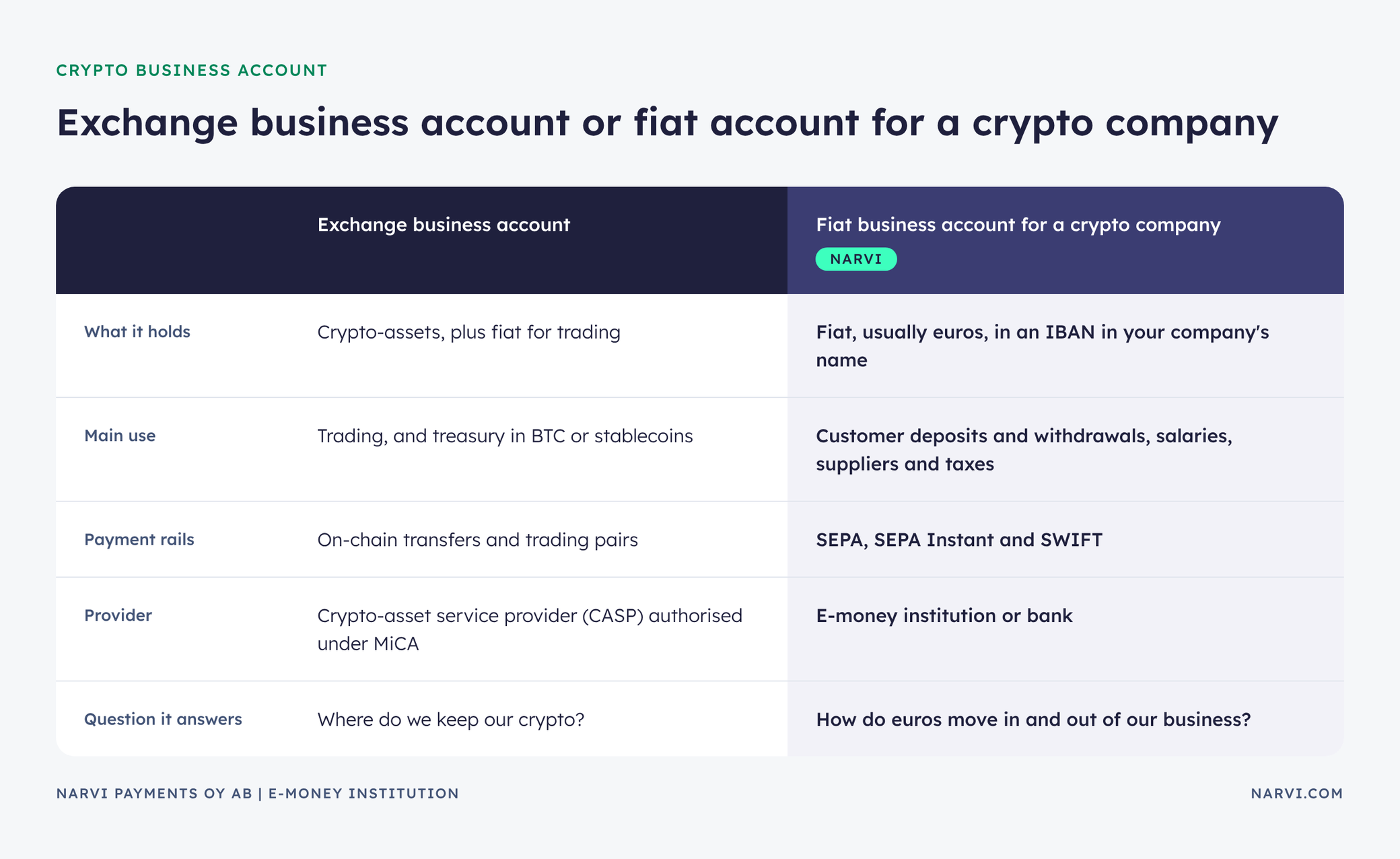
Can a crypto company use a traditional bank?
Some can. Many traditional banks offer a business bank account to crypto companies only under strict conditions, or not at all, and some close accounts when a client's crypto activity grows. That is why many crypto businesses look for banking services from an e-money institution instead.An EMI and a bank both issue IBANs and run SEPA and SWIFT payments. The difference is what happens to client money. A bank can lend it; an EMI cannot, and must safeguard it instead. For a crypto company that needs a fiat currency account rather than credit, that is rarely a drawback. Our guide to alternative banking and EMIs covers the difference in detail.What changed with MiCA
MiCA, Regulation (EU) 2023/1114, has applied to crypto-asset service providers (CASPs) since 30 December 2024. Firms already operating under a national regime could keep going during a transitional period, but that period ended on 1 July 2026 at the latest, and earlier in several member states. Finland, for example, allowed six months, to 30 June 2025, as Elliptic's summary of national transitional periods notes.For an account application, that changes the first question. Before MiCA, providers asked which national register you were on. Now they ask whether you hold a CASP authorisation, and if you don't, why your activity falls outside MiCA. A pending application is not an authorisation. ESMA publishes an interim MiCA register that providers use to check.The second change is the travel rule. Since 30 December 2024, the Transfer of Funds Regulation (EU) 2023/1113 has required CASPs to send and receive originator and beneficiary information with crypto transfers, as payment providers already do for wire transfers. Account providers expect to see how you comply.What account providers check before they open a crypto business account
Crypto companies get more due diligence than most business clients, because EU supervisors treat crypto-assets as a higher money laundering risk. Expect the provider to look at six things.1. Your business modelWhich services you offer (on-ramp only, on and off-ramp, exchange, custody, OTC), which countries you serve and whether your customers are consumers, businesses or both.2. Your authorisationA MiCA CASP authorisation, or a clear explanation of why your activity doesn't need one.3. Ownership and controlEveryone who owns or controls the business, directly or through other companies. For crypto businesses, Narvi recommends identifying owners down to a 10% shareholding.4. Source of wealth and source of fundsHow the founders made the money used to start and run the business, with documents to back it up. See our glossary entries on source of funds and source of wealth.5. Your counterpartiesWho you expect to send money to and receive it from, and in which jurisdictions.6. Your compliance set-upAML policy, risk assessment, blockchain analytics and wallet screening, sanctions screening, travel rule tooling, and an independent AML responsible person. If that person is also a director or beneficial owner, expect the provider to push back. This catches many early-stage firms.Documents to prepare for a crypto business account
Have these ready before you start the application. Narvi's VASP onboarding guide and the general list of required documents cover the details.- Certificate of incorporation and articles of association.
- Identity documents for directors and ultimate beneficial owners, and documents confirming beneficial ownership.
- Tax identification documents for the company and its owners.
- Your CASP authorisation or other licence or registration, or a written explanation of why none is required.
- AML policy and business-wide risk assessment.
- A short description of your flows: expected monthly volumes, currencies, countries and main counterparties.
- Optional but useful: financial statements, statements from your current account provider, and contracts with key customers or suppliers.
How the application process works
The application process for a crypto business account follows the same steps at most providers. How long it takes depends mostly on how complete your first submission is.- You fill in the onboarding questionnaire and upload company and ownership documents.
- Directors and beneficial owners complete identity verification.
- The compliance team reviews the file and sends follow-up questions, usually about flows, source of funds or authorisation.
- Once approved, the account opens and you receive your IBAN.
- After opening, the provider keeps up transaction monitoring and sanctions screening, and reviews the account periodically.
What a crypto business account is used for
Once the account is open, most of the fiat transactions a crypto company runs fall into four groups.- Receiving payments from customers who fund their accounts in euros.
- Paying out customer withdrawals, often by SEPA Instant.
- Paying bills: salaries, suppliers, auditors, lawyers and taxes.
- Transferring funds between your own accounts and to business clients and partners.
Why crypto companies lose their accounts
Account closures in crypto often follow a gap between what the company declared at onboarding and what the account then shows: new countries, new products, a new payment partner or volumes far above the forecast. Providers see the change in the transaction data, sometimes before the company has explained it.Others come from de-risking, where a provider exits a whole category of clients. The fix is the same as in any high-risk sector. Tell your provider before your flows change, keep your authorisation and policies up to date on file, and hold a second account so an exit doesn't stop customer withdrawals.Questions to ask a provider before you apply
An account that closes six months in is worse than no account. Before you apply, ask any provider these five questions.- Do you onboard my business model, and in which countries do you accept customers?
- Is the IBAN issued in my company's own name, or is it a reference on a pooled account?
- Which payment rails can I use: SEPA, SEPA Instant, SWIFT?
- How are client funds protected if you fail: safeguarding, or deposit insurance?
- What do you need from me when my flows, products or markets change?
How Narvi works with crypto companies
Narvi Payments Oy Ab is an e-money institution authorised by the Finnish Financial Supervisory Authority (FIN-FSA), with its licence passported across the EEA. We provide fiat accounts and payment infrastructure to exchanges, OTC desks, custodians and wallet providers, DeFi entities and other Web3 companies.For exchanges and OTC desksA dedicated IBAN per entity for customer fiat deposits and withdrawals, SEPA Instant settlement and API payment initiation with status webhooks.For custodians and wallet providersFiat accounts and payments under your own brand through Banking as a Service, so your users stay in your interface while Narvi runs the regulated payment layer.For every crypto business account, you get:- A dedicated IBAN in your company's name, issued by Narvi under its own BIC, so your name appears on payments.
- SEPA Instant and standard SEPA for euro deposits and withdrawals, plus SWIFT for payments outside SEPA.
- API access for payment initiation, webhooks and reconciliation.
- Banking as a Service for wallet providers and platforms that want to offer fiat accounts to their own users.

Talk to our team about a business account for your crypto company

Frequently Asked Questions
It is a business payment account for a company that works with crypto-assets. For most crypto companies that means a fiat account with an IBAN in the company's name, used for customer deposits and withdrawals, salaries, suppliers and taxes. Some exchanges also use the term for business accounts that hold crypto.
If you provide crypto-asset services in the EU, you need CASP authorisation under MiCA, and account providers will ask for it. The transitional period for firms operating under national regimes ended on 1 July 2026 at the latest. If your activity falls outside MiCA, be ready to explain why.
No. A Narvi account is a fiat e-money account. It holds euros and runs SEPA and SWIFT payments, but it does not hold, buy or sell crypto-assets.
Yes, if the EMI accepts crypto clients. EMIs are authorised under the Electronic Money Directive, issue IBANs and safeguard client funds. Expect enhanced due diligence on your authorisation, ownership, source of funds and compliance set-up.
Usually because information is missing or unclear: an unexplained group structure, a missing authorisation, documents that aren't translated or certified, or an AML responsible person who is also a director or owner. Sending complete documents with the first submission avoids many of these.

Last updated: 16 November 2026. Narvi Payments Oy Ab is an authorised Electronic Money Institution licensed by the Finnish Financial Supervisory Authority (FIN-FSA), registration number 3190214-6.DisclaimerThis publication is provided for general information purposes and does not constitute legal, tax, or other professional advice from Narvi Payments Oy Ab or its affiliates, and it is not intended as a substitute for obtaining advice from a financial advisor or any other professional.
Read next:
The Markets in Cryptoassets (MiCA) EU Regulation
What MiCA covers, who needs authorisation and how it changes the EU crypto market.
Alternative banking: what an EMI is and how it differs from a bank
How e-money institutions work, what they can and cannot do, and when they are the better fit.
What happens to your money if an EMI fails? Safeguarding, explained
How e-money institutions protect client funds, and what that means for your business.

Soluciones
IBAN Accounts For Your Business
Empieza aquí
Acerca de Narvi (EN)
Alternative Investment Funds [whitepaper]Family Offices [whitepaper]Shipping Industry [whitepaper]How to Open a Business Account in FinlandNarvi vs. Wise, Revolut, N26, and other alternativesNarvi vs. Stable.comNarvi vs. payabl.Narvi vs. ConnectPayNarvi vs. IBAN4UNarvi vs. GenomeNarvi vs. PaxumNarvi vs. BilderlingsNarvi vs. NetellerNarvi vs. KontistBlogPayments Glossary


Narvi Payments Oy Ab es una institución de dinero electrónico (EMI) autorizada. La licencia EMI de Narvi la otorga la Autoridad de Supervisión Financiera de Finlandia (FIN FSA) con el número de registro 3190214-6. La licencia de Narvi tiene validez para todos los países de la Unión Europea.
 Construido y regulado por Finlandia
© 2026 Narvi. All Rights Reserved.
v1.335.0