Banking as a service (BaaS): how it works and how it differs from embedded finance
Banking as a service lets a platform offer accounts, IBANs and payments to its own customers on a licensed provider's infrastructure. Here is how it works in the EEA, how it compares with embedded finance, open banking and white label, and what to check in a provider.

Banking as a service (BaaS) is a model in which a licensed financial institution lets another company offer accounts, IBANs and payments to its own customers through an API. The licensed provider holds the regulatory permission, safeguards the funds and runs compliance. The company on top builds the product and owns the customer experience.If you run a fintech, a marketplace, a PSP or a SaaS platform and want your users to hold money and send payments inside your product, banking as a service is how you get there without first becoming a regulated institution yourself. This guide explains how BaaS works in the EEA, how it differs from embedded finance and white label, and what to check before you pick a provider.

What is banking as a service?
Banking as a service is the regulated layer behind a financial product. A licensed institution, either a licensed bank or an e-money institution (EMI), exposes its banking infrastructure (accounts, payment rails and onboarding) through an API. A non-bank business connects to that API and offers financial services under its own brand. That business can be one of the fintech companies building a financial app, a tech company adding payments, or one of the many non-financial companies that simply want their customers to hold and move money.Three parties are involved:- The BaaS provider holds the licence, issues the IBANs, connects to payment schemes such as SEPA, safeguards client money and makes the final compliance decision on every customer.
- The platform (sometimes called the distributor) builds the interface, designs the customer journey and decides how financial features fit its product.
- The end user opens an account inside the platform's app and uses it day to day, often without knowing which licensed institution sits underneath.
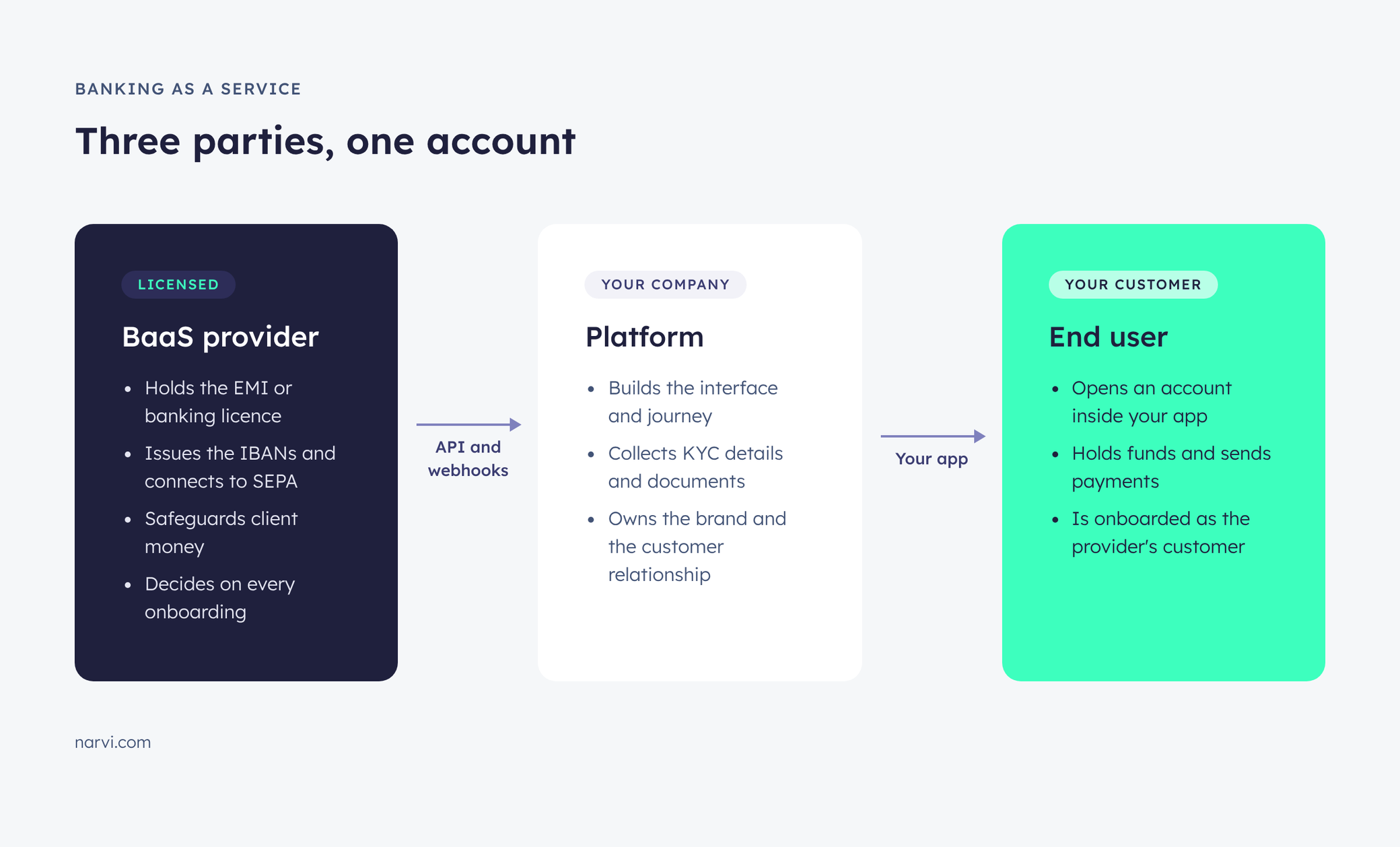
How banking as a service works
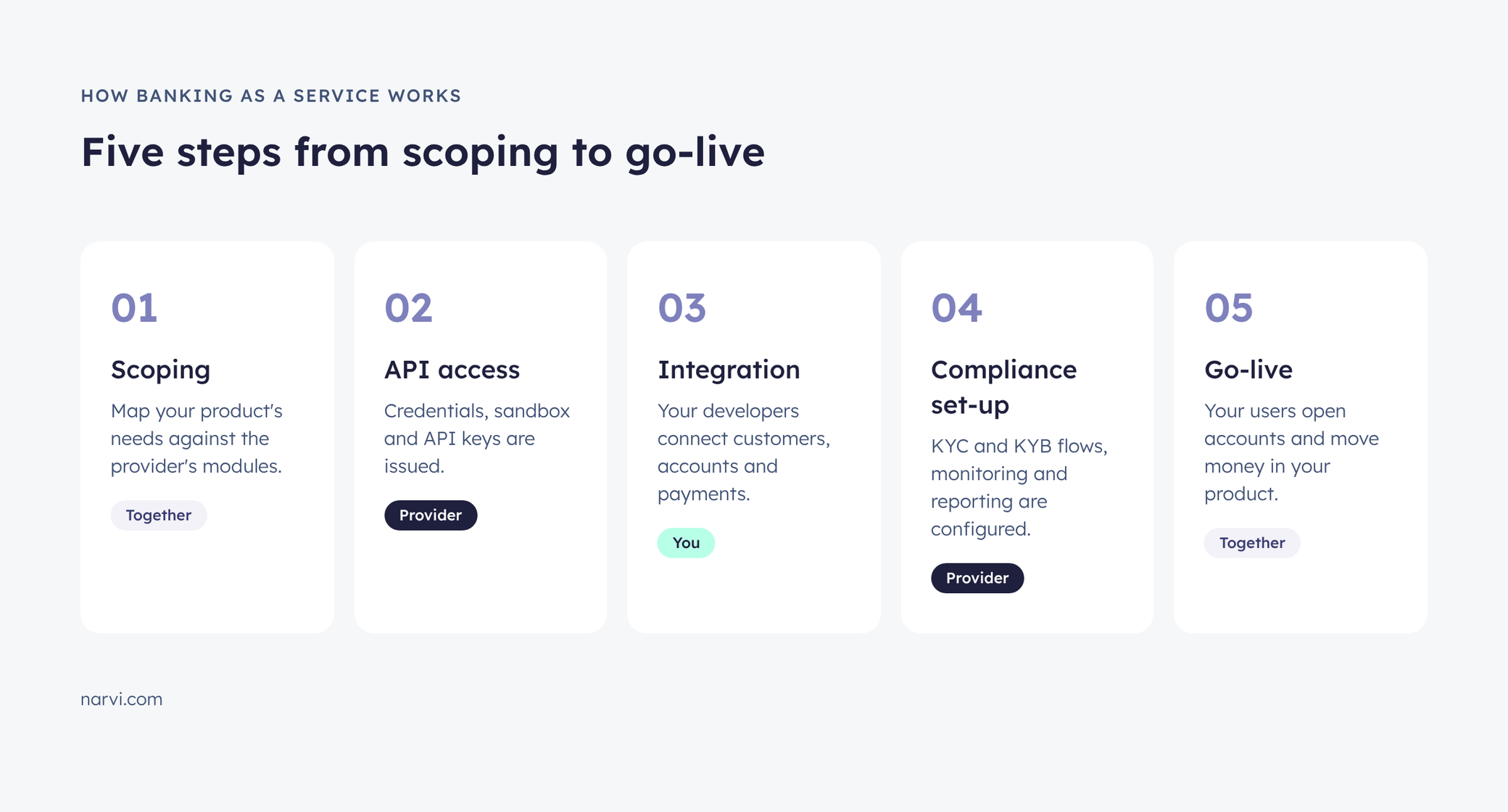
Most BaaS set-ups follow the same five steps, whichever provider you choose.- Scoping. You map what your product needs (accounts, IBANs, euro payments, onboarding, cards) against the provider's modules and agree which ones you will integrate.
- API access. The provider issues credentials, a sandbox and API keys. Integration usually runs over a REST API with webhooks that tell your system when a payment arrives or a customer's status changes.
- Integration. Your developers connect the endpoints: creating customers, uploading their documents, opening accounts, instructing payments and reading balances and transactions.
- Compliance set-up. The provider configures KYC and KYB flows, transaction monitoring and reporting for your use case. You collect the information, the provider reviews it and decides.
- Go-live. Your users open accounts and move money inside your product, while the provider runs the regulated infrastructure behind it.
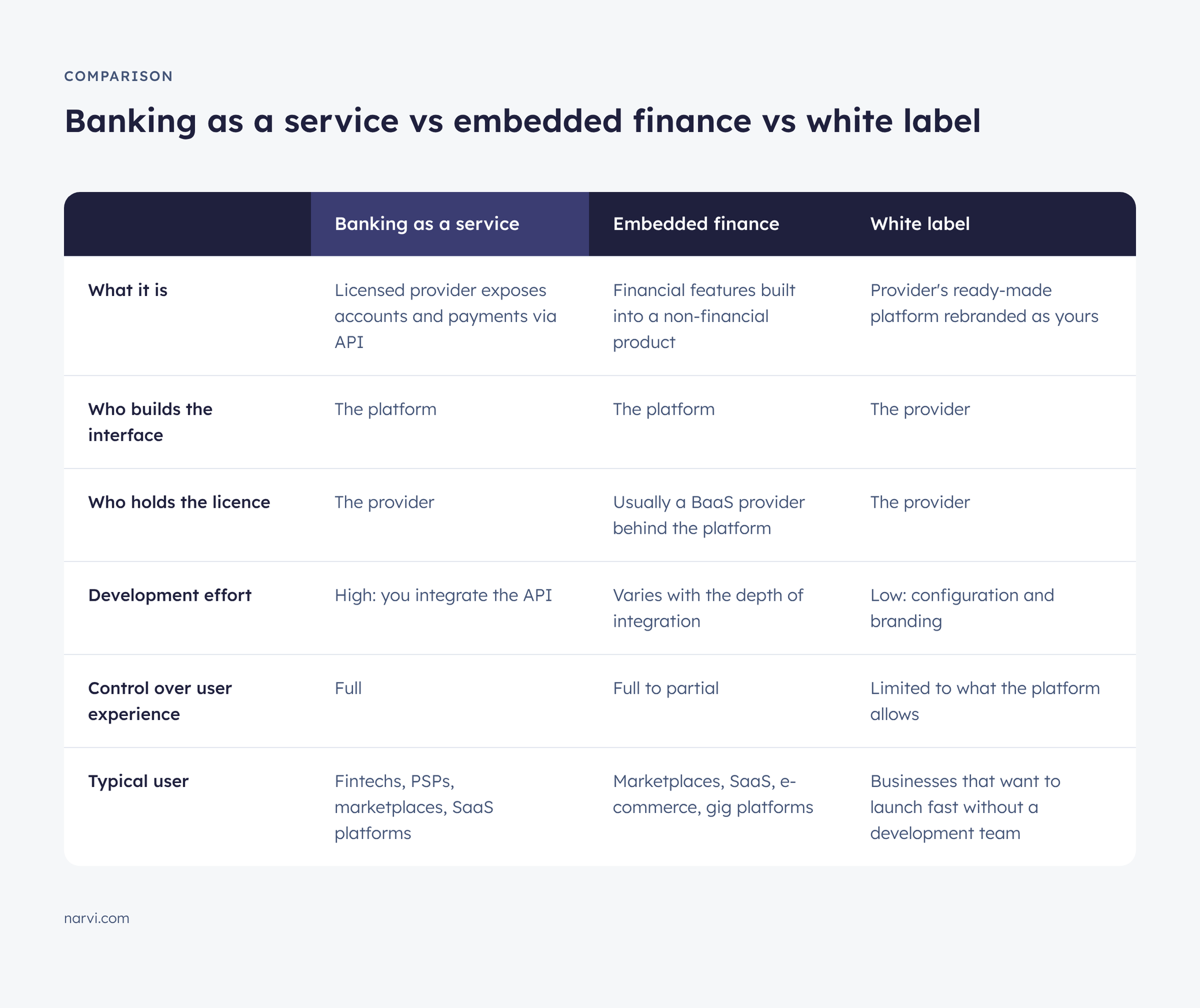
Banking as a service vs embedded finance
The two terms are often used as if they meant the same thing. They describe different sides of one arrangement.- Banking as a service is the supply side: the licensed provider and the API it exposes.
- Embedded finance is the demand side: a non-financial or fintech business putting financial features into its own product, such as a marketplace that gives each seller an IBAN, or an accounting tool that lets users pay invoices without leaving the app.
Banking as a service vs open banking
Open banking and banking as a service are often confused because both run on APIs. They solve different problems.Open banking lets a licensed third party provider read banking data or start a payment from an account the customer already holds elsewhere, with the customer's consent. In the EU it comes from PSD2, which created account information and payment initiation services. Banking as a service creates new accounts: the provider uses its licence to provide banking services, and the platform's customers hold their money there. A platform can use both, for example open banking to let a user top up from their existing account and BaaS to give that user an IBAN of their own.Banking as a service vs white label
White label and BaaS both let you offer accounts under your own brand on someone else's licence. The difference is who builds the product. With BaaS, you build your own interface and connect it to the provider's API, so you control the whole experience. With white label, you take the provider's existing platform and rebrand it, which needs far less development but gives you less control over the journey.If financial features are the core of your product, BaaS is usually the better fit. If you want to offer accounts as a side service and you don't have a development team to spare, white label may be enough.Banking as a service vs virtual IBANs
A virtual IBAN set-up looks similar from the outside but works differently. With virtual IBANs, you hold one main business account and the provider issues extra account numbers under it, one per customer, invoice or flow. You remain the account holder, your end users never become the provider's customers, and KYC runs once, on your company. With BaaS, each end user holds their own account with the provider and goes through onboarding.The organising question is who controls the account. If your customers need to sign in, hold funds in their own name and move money themselves, you need banking as a service. If you only need to collect and reconcile incoming payments, virtual IBANs are often the simpler route.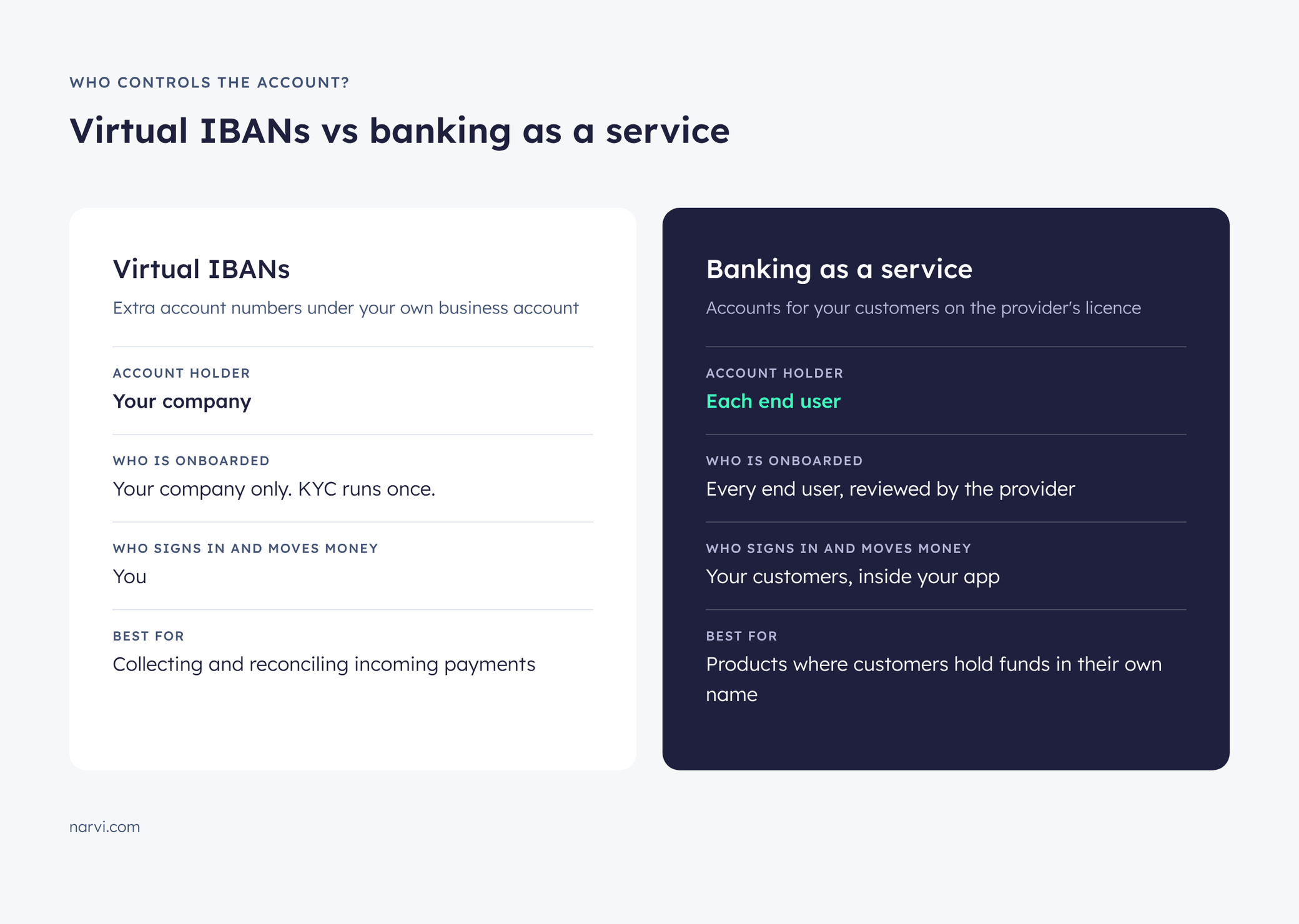
Who uses banking as a service?
- Fintech start-ups that want to launch a business or consumer account product without waiting for their own licence.
- Marketplaces and platforms that need a dedicated IBAN per seller and payments between buyers, sellers and the platform with funds kept apart.
- PSPs and payment facilitators that already move money and want to add IBAN accounts and euro settlement to their offer without applying for an EMI licence.
- Crypto and Web3 companies with a MiCA authorisation that need euro accounts for their customers' on- and off-ramps.
- SaaS platforms in invoicing, payroll or treasury, where letting users hold and send money inside the app opens a new revenue line.
How to choose a banking as a service provider
Banking as a service providers differ less in their API documentation than in what sits behind it. Five questions will tell you most of what you need to know.- Whose licence is it, and where is it passported? Check the provider in its home regulator's public register and confirm that the licence is passported to every country where your users are.
- How is client money safeguarded? Ask where the funds sit, whether they are segregated from the provider's own money, and what happens to them if the provider fails.
- Who decides on onboarding, and how fast? Ask what the provider's compliance team needs from you, how decisions come back through the API, and whether it accepts your industry and your customers' industries.
- Which payment rails are live? Confirm SEPA Credit Transfer, SEPA Instant and any non-euro or SWIFT capability for BaaS accounts specifically, not only for the provider's own business accounts.
- What does integration support look like? Ask about sandbox access, webhook coverage, libraries for your stack, and who you talk to when an integration question comes up.
Banking as a service with Narvi
Narvi Payments Oy Ab is an e-money institution authorised by the Finnish Financial Supervisory Authority (FIN-FSA), with its licence passported across the EEA. Its BaaS API lets you create private and business customers, upload their documents, follow each customer's KYC status, open euro accounts with dedicated IBANs and create and track euro transactions, with Verification of Payee on SEPA transfers. Narvi's compliance team reviews every customer, and reusable KYC through Sumsub is available.The API is REST-based, with real-time webhooks and integration libraries for Node.js and Python. Every integration follows the same path: a scoping call, API access, integration with support from Narvi's technical team, compliance set-up and go-live. Narvi works with fintechs, marketplaces, PSPs, SaaS platforms and licensed crypto companies, including the higher-risk sectors many providers turn away.If you want accounts and payments inside your product, see how Narvi BaaS works or read the BaaS API documentation.
Talk to our team about embedding accounts and payments in your product

Frequently Asked Questions
Banking as a service lets a company offer accounts and payments to its own customers by connecting to a licensed provider's API. The provider holds the licence and the funds. The company builds the product.
Banking as a service is the licensed infrastructure and the API. Embedded finance is the financial feature a platform puts inside its product. BaaS is one of the main ways to deliver embedded finance.
Usually not for the accounts and payments themselves, because they run on the provider's licence. Whether your wider business model needs its own authorisation depends on what else you do, so check it with your provider and legal adviser at the start.
No. In the EEA, many BaaS providers are e-money institutions rather than traditional banks. A bank offering BaaS can also provide lending, such as loans and credit lines. An EMI can issue e-money accounts and execute payments, but it does not lend client money and balances are not covered by a deposit guarantee scheme.
With BaaS you build your own interface on the provider's API. With white label you rebrand the provider's ready-made platform. BaaS gives more control, white label needs less development.

Last updated: 23 November 2026. Narvi Payments Oy Ab is an authorised Electronic Money Institution licensed by the Finnish Financial Supervisory Authority (FIN-FSA), registration number 3190214-6.DisclaimerThis publication is provided for general information purposes and does not constitute legal, tax, or other professional advice from Narvi Payments Oy Ab or its affiliates, and it is not intended as a substitute for obtaining advice from a financial advisor or any other professional.
Read next:
Alternative banking: what an EMI is and how it differs from a bank
How e-money institutions work, what they can and cannot do, and when they are the better fit.
What happens to your money if an EMI fails? Safeguarding, explained
How e-money institutions protect client funds, and what that means for your business.
Crypto business account: how crypto companies open a fiat account in the EEA
What account providers check after MiCA and which documents to prepare.

What We Offer
IBAN Accounts For Your Business
Support & Compliance
Narvi Knowledge Center
Alternative Investment Funds [whitepaper]Family Offices [whitepaper]Shipping Industry [whitepaper]How to Open a Business Account in FinlandNarvi vs. Wise, Revolut, N26, and other alternativesNarvi vs. Stable.comNarvi vs. payabl.Narvi vs. ConnectPayNarvi vs. IBAN4UNarvi vs. GenomeNarvi vs. PaxumNarvi vs. BilderlingsNarvi vs. NetellerNarvi vs. KontistPayments BlogPayments Glossary


Narvi Payments Oy Ab is an Authorized Electronic Money Institution (EMI). Narvi’s EMI license is granted by the Finnish Financial Supervisory Authority (FIN FSA) with the registration number 3190214-6. Narvi’s license is passportised to all European Union countries.
 Built and regulated in Finland
© 2026 Narvi. All Rights Reserved.
v1.337.0