Correspondent bank
A correspondent bank is a bank that holds accounts for another financial institution and makes or receives payments on its behalf, usually in a currency or country that institution can't reach directly. International SWIFT payments often pass through one or more correspondents before they reach the beneficiary's provider.

How a payment moves through correspondents
No institution has an account with every other institution in the world. When a payment has to go somewhere its sender's institution can't reach directly, it travels through banks that hold accounts for each other.- A company in Finland pays a supplier in Singapore in US dollars.
- Its provider has no account in Singapore, so it sends the payment to its US dollar correspondent, a bank that holds dollars on its behalf.
- The correspondent debits the provider's account and passes the payment on, either straight to the supplier's bank or through a second correspondent that has a relationship with it.
- The supplier's bank credits the supplier's account.
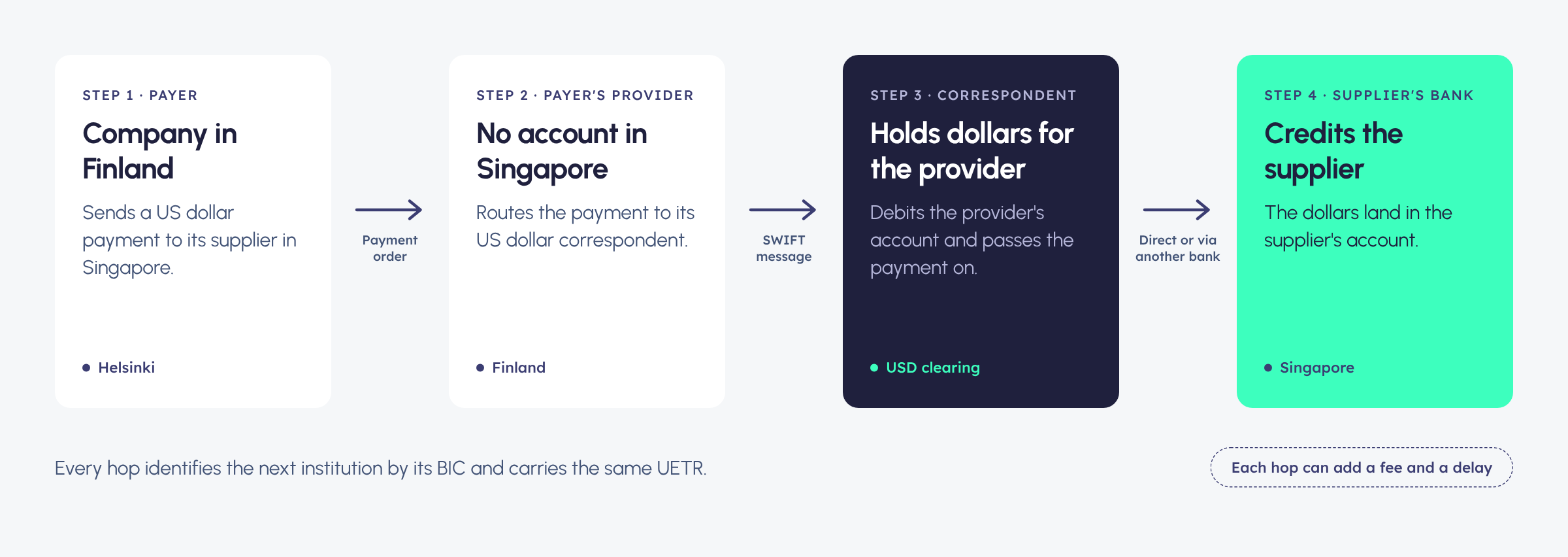 Each institution identifies the next one by its BIC, and every hop carries the same UETR, which is how the payment can be traced through the chain.

Nostro and vostro accounts
A correspondent relationship rests on one account seen from two sides: the institution's nostro account and the correspondent's vostro account. See nostro and vostro accounts for how they work.Correspondent vs intermediary vs beneficiary bank
| Correspondent bank | Intermediary bank | Beneficiary bank | |
|---|---|---|---|
| Role | Holds an account for another institution and settles payments for it | Any bank a payment passes through between sender and beneficiary | The bank or provider that holds the beneficiary's account |
| Relationship | A standing account relationship | Can be a correspondent, or one further along the chain | The payment's destination |
| In a SWIFT message | Often the intermediary institution field | Intermediary institution | Account with institution |
Why correspondent chains cost time and money
Each correspondent can take a fee. If the payer chose SHA or BEN charges, those fees come out of the amount on the way, which is why a supplier can receive less than the invoice. Under OUR, the payer covers them.Each hop also adds time: different cut-off times and time zones, and each bank runs its own sanctions and compliance checks before passing the payment on. A payment that clears in hours through one correspondent can take days through three. See how SWIFT payments work for the full picture.Correspondent de-risking
Correspondent relationships carry compliance risk for the correspondent, which has to trust its client's checks on the payments it passes on. Over the last decade, many large banks have cut relationships with smaller banks and markets they considered too costly to monitor, and the Bank for International Settlements has tracked a steady fall in active correspondent relationships. [CONFIRM: add a figure only from the BIS CPMI correspondent banking data, with its date.]For businesses, this is one of the reasons payments to some countries take longer and cost more. It's also part of the wider pattern of debanking.FAQ
Ask your provider, or the beneficiary's, to trace the payment by its UETR. The SWIFT GPI tracker records each bank the payment passed through. See how to track a SWIFT payment.
Most likely, one or more correspondents deducted a fee on the way, because the payment was sent with SHA or BEN charges. The charges option in the payment message shows which.
Not in the same way. SEPA payments within the EEA settle through European clearing systems, so they don't need a chain of correspondents. Correspondents matter for SWIFT payments, especially in non-euro currencies.
Related terms and sources
Nostro and vostro accounts · SWIFT GPI · OUR, SHA and BEN · BIC code · MT103 · UETR · Debanking · Browse the full glossaryFor the system view, see how correspondents fit into the SWIFT network.- Bank for International Settlements, CPMI: Correspondent banking [CONFIRM: check this link resolves to the CPMI correspondent banking report before publishing]

Last reviewed October 21, 2026Disclaimer
This publication is provided for general information purposes and does not constitute legal, tax, or other professional advice from Narvi Payments Oy Ab or its affiliates, and it is not intended as a substitute for obtaining advice from a financial advisor or any other professional.
This publication is provided for general information purposes and does not constitute legal, tax, or other professional advice from Narvi Payments Oy Ab or its affiliates, and it is not intended as a substitute for obtaining advice from a financial advisor or any other professional.


What We Offer
IBAN Accounts For Your Business
Support & Compliance
Narvi Knowledge Center
Alternative Investment Funds [whitepaper]Family Offices [whitepaper]Shipping Industry [whitepaper]How to Open a Business Account in FinlandNarvi vs. Wise, Revolut, N26, and other alternativesNarvi vs. Stable.comNarvi vs. payabl.Narvi vs. ConnectPayNarvi vs. IBAN4UNarvi vs. GenomePayments BlogPayments Glossary


Narvi Payments Oy Ab is an Authorized Electronic Money Institution (EMI). Narvi’s EMI license is granted by the Finnish Financial Supervisory Authority (FIN FSA) with the registration number 3190214-6. Narvi’s license is passportised to all European Union countries.
 Built and regulated in Finland
© 2026 Narvi. All Rights Reserved.
v1.322.0