BIC vs SWIFT code: are they the same thing?
Yes. A BIC and a SWIFT code are the same identifier. Here is what the 8 or 11 characters mean, how a BIC differs from an IBAN, when a payment still needs one and where to find yours.

Yes. A BIC and a SWIFT code are the same thing: an 8 or 11-character code, defined by the international standard ISO 9362, that identifies a financial institution in a payment. Swift (the Society for Worldwide Interbank Financial Telecommunication), the cooperative that runs the global financial messaging network, issues the codes.That is why people call them SWIFT codes.You will see the same code labelled BIC, SWIFT code, SWIFT BIC or BIC code depending on the provider, the form or the country.This guide explains what the characters mean, how a BIC differs from an IBAN, when a payment still needs one, and where to find yours.

Is a BIC the same as a SWIFT code?
The BIC is the official name and SWIFT code is the everyday one. BIC originally stood for Bank Identifier Code. The standard now calls it the Business Identifier Code, because the codes are also issued to institutions that are not banks, such as e-money institutions, payment institutions, brokers and corporates.Swift acts as the registration authority for ISO 9362. It assigns each code, publishes the directory and keeps it up to date.The code itself is the same whatever you call it. If a form asks for a SWIFT code and you have a BIC, enter the BIC.A few labels cause confusion:- SWIFT BIC and BIC code are the same code under a longer name.
- BIC8 and BIC11 are the 8 and 11-character versions of the same identifier.
- IBAN is a different thing: it identifies an account, not an institution (see below).
- Sort code, routing number and bank code are national identifiers used in some countries' domestic systems, not BICs.
What the 8 or 11 characters of a BIC mean
Every BIC follows the same structure. The first 8 characters are always present; the last 3 are optional.Take Narvi's code, NARYFIH2. NARY identifies Narvi Payments Oy Ab, FI identifies Finland and H2 the location. You will sometimes see it written as NARYFIH2XXX: the extra XXX points to the head office and means the same as the 8-character version.BIC8 or BIC11: which one do you use?If the institution gives you an 8-character code, use it as it is. If a form insists on 11 characters and you have no branch code, adding XXX to the end is the standard way to complete it. Use a specific branch code only if your provider tells you to.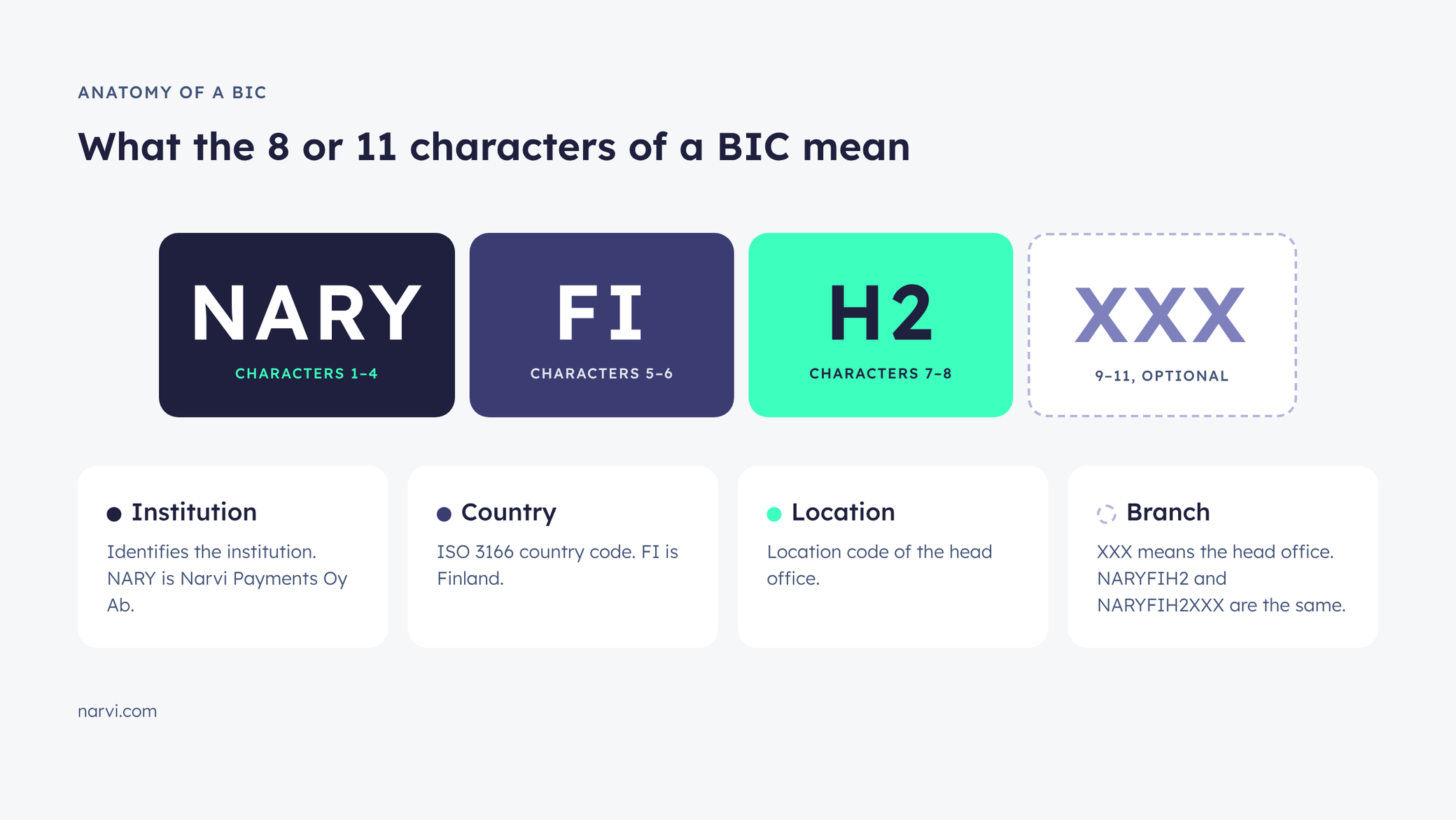
BIC vs IBAN: what is the difference?
A BIC tells the payment system which institution to send the money to. An IBAN (International Bank Account Number) tells the receiving bank or institution which individual account to credit.Most international transfers need both, and they are often printed side by side in your bank details or account details.Because a BIC is shared, it is not sensitive information on its own.An IBAN identifies your account, so treat it with the same care as any account number, even though you have to share it to get paid.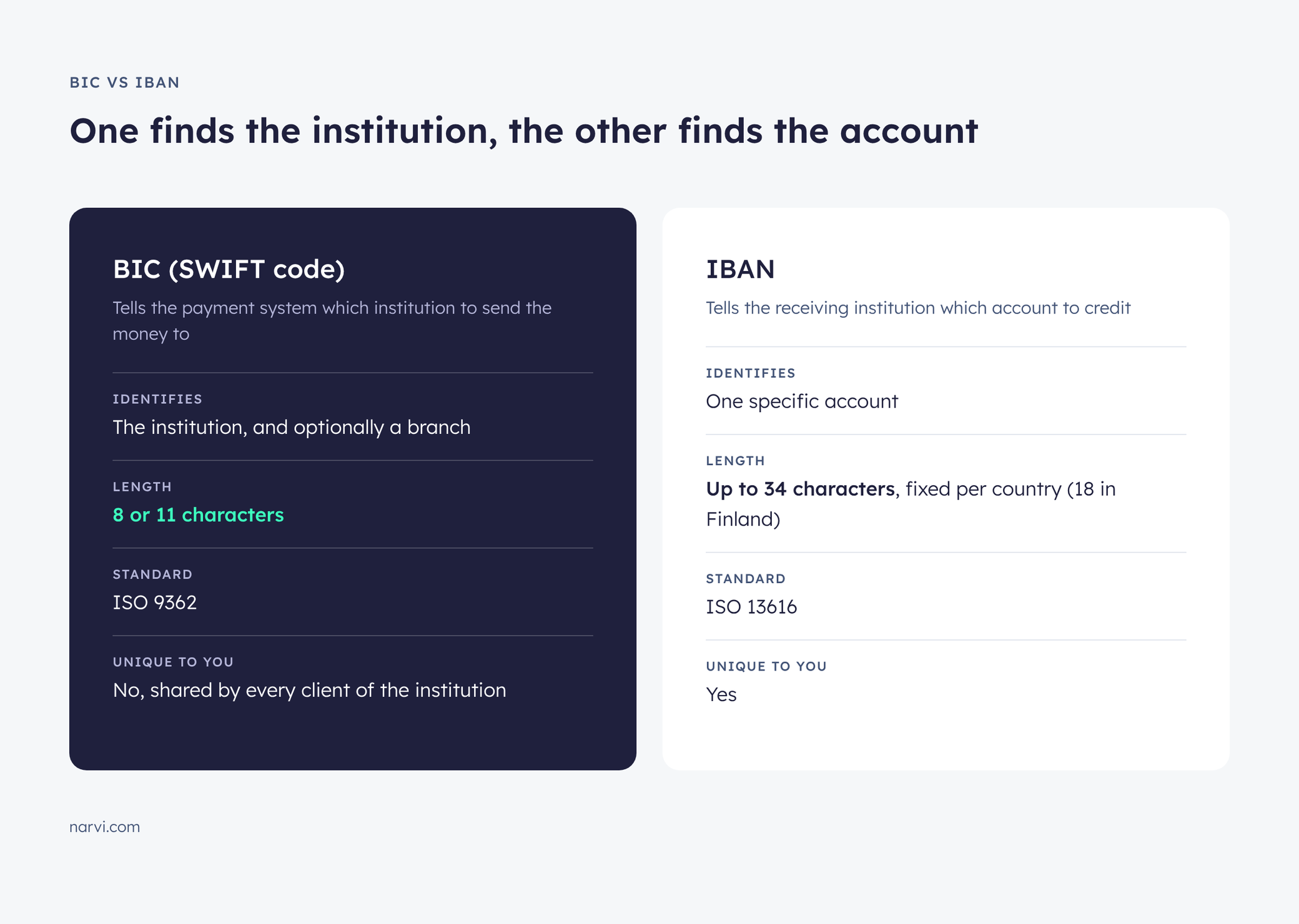
When does a payment still need a BIC?
Euro payments within SEPAFor euro transfers between accounts in the Single Euro Payments Area (SEPA), the IBAN is enough. The SEPA Regulation, Regulation (EU) No 260/2012, removed the requirement for payers to supply a BIC: for domestic payments from February 2014 and for cross-border euro payments within the EU from 1 February 2016. The payment provider works out the receiving institution from the IBAN. This is often called the IBAN-only rule, and it applies to SEPA direct debits as well as credit transfers in euro across Europe.Some forms and older systems still ask for a BIC on SEPA payments. Supplying it does no harm, but a missing BIC is no longer a valid reason to reject a SEPA transfer.International payments outside SEPAFor payments in other currencies, or to countries outside SEPA, the payment usually travels over the Swift network and the BIC is required. You need the beneficiary institution's BIC, the beneficiary name, and the recipient's IBAN in countries that use IBANs, or the local account number where they do not. Some people still call this a wire transfer.Some payments also pass through intermediary institutions, each with its own BIC. Our guide to SWIFT payments explains how that chain works.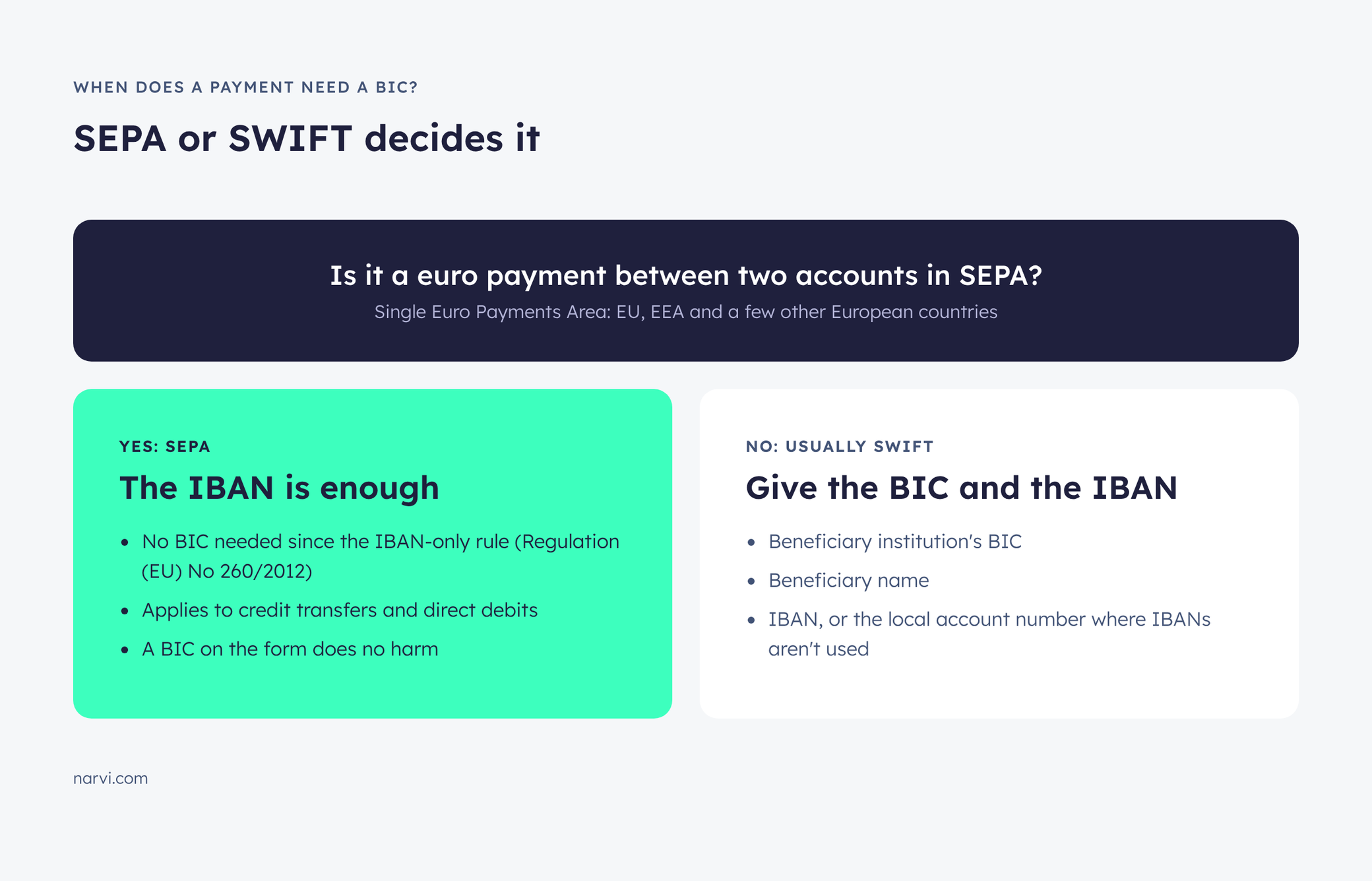
Where to find your BIC
Use the code your own provider gives you. The most reliable places are:- Your account details in your online dashboard or app, usually next to your IBAN.
- Your account statement or account confirmation letter.
- Your provider's website, often in the help centre or the page on receiving international payments.
- Swift's own BIC search on swift.com, which checks a code against the official directory.
BIC and SWIFT with a Narvi account
Narvi Payments Oy Ab is an e-money institution authorised by the Finnish Financial Supervisory Authority (FIN-FSA). Each Narvi business account comes with a dedicated IBAN in your company's own name, issued under Narvi's own BIC, so payers see your company as the account holder.Your BIC and IBAN are shown together in your account details in the Narvi dashboard.Use the IBAN on its own for euro payments within SEPA, including SEPA Instant. For international payments, give payers both, and see the euro SWIFT IBAN account page for how SWIFT payments work with Narvi.
Get a dedicated IBAN in your company's own name

Frequently Asked Questions
Yes. BIC is the official name in the ISO 9362 standard and SWIFT code is the everyday name, because Swift issues the codes. They refer to the same 8 or 11-character identifier.
No. For euro payments within SEPA, the IBAN is enough. EU rules removed the BIC requirement for cross-border euro transfers in February 2016.
XXX is the branch code for the head office. NARYFIH2 and NARYFIH2XXX point to the same institution.
No. The BIC identifies the institution, the IBAN identifies one account at that institution. IBAN length is fixed per country, up to 34 characters. International payments outside SEPA usually need both.
Yes. A BIC is shared by every client of the same institution and is published in public directories. Share your IBAN only with people who need to pay you.

Last updated: 23 November 2026. Narvi Payments Oy Ab is an authorised Electronic Money Institution licensed by the Finnish Financial Supervisory Authority (FIN-FSA), registration number 3190214-6.DisclaimerThis publication is provided for general information purposes and does not constitute legal, tax, or other professional advice from Narvi Payments Oy Ab or its affiliates, and it is not intended as a substitute for obtaining advice from a financial advisor or any other professional.
Read next:
What are SWIFT payments and how do they work?
How a SWIFT payment moves, what it costs and how it compares with SEPA.
How to track SWIFT payments
What to ask your provider when an international payment has not arrived.
Banking as a service (BaaS): how it works
How platforms offer IBAN accounts and payments on a licensed provider's infrastructure.

What We Offer
IBAN Accounts For Your Business
Support & Compliance
Narvi Knowledge Center
Alternative Investment Funds [whitepaper]Family Offices [whitepaper]Shipping Industry [whitepaper]How to Open a Business Account in FinlandNarvi vs. Wise, Revolut, N26, and other alternativesNarvi vs. Stable.comNarvi vs. payabl.Narvi vs. ConnectPayNarvi vs. IBAN4UNarvi vs. GenomeNarvi vs. PaxumNarvi vs. BilderlingsNarvi vs. NetellerNarvi vs. KontistPayments BlogPayments Glossary


Narvi Payments Oy Ab is an Authorized Electronic Money Institution (EMI). Narvi’s EMI license is granted by the Finnish Financial Supervisory Authority (FIN FSA) with the registration number 3190214-6. Narvi’s license is passportised to all European Union countries.
 Built and regulated in Finland
© 2026 Narvi. All Rights Reserved.
v1.337.0